Online Course
Introducing Data Structures in Python

Learn Python’s core data structures—from lists and stacks to dictionaries and trees—and choose the right one for each problem.

4.9

870 reviews on
7 students already enrolled
  • Institute of Analytics
  • E-Learning Quality Network
  • European Agency for Higher Education and Accreditation
  • Global Association of Online Trainers and Examiners

Skill level:

Basic

Duration:

1 hour
  • Lessons (1 hour)

CPE credits:

2
CPE stands for Continuing Professional Education and represents the mandatory credits a wide range of professionals must earn to maintain their licenses and stay current with regulations and best practices. One CPE credit typically equals 50 minutes of learning. For more details, visit NASBA's official website: www.nasbaregistry.org

Accredited

certificate

What you learn

  • Understand how data structures shape data organization and access
  • Use lists, stacks, and queues for ordered data and rule-based workflows
  • Apply sets and dictionaries for fast lookup, uniqueness, and key–value data
  • Represent and traverse trees to model hierarchy and decision logic
  • Choose efficient data structures for real-world problems and performance

Topics & tools

Data StructuresData LiteracyData AnalysisData PreprocessingProgrammingPython

Your instructor

Course OVERVIEW

Description

CPE Credits: 2 Field of Study: Information Technology
Delivery Method: QAS Self Study

This course is a practical and conceptual introduction to data structures using Python, designed as a natural follow-up to Introducing Algorithms in Python. Rather than focusing on low-level implementations or abstract theory, the course emphasizes how data is organized, why structure matters, and how structure affects performance and problem-solving.

You’ll begin by revisiting the idea of data as collections and explore Python lists as everyday sequences. From there, you’ll move to rule-based linear structures such as stacks and queues, learning how access restrictions shape behavior and use cases. The course then shifts to fast, non-linear lookup structures—sets and dictionaries—highlighting how hashing enables efficient membership testing and key-value access.

Finally, you’ll explore trees, the first truly hierarchical structure in the course, where data branches rather than lines up. You’ll learn tree terminology, binary trees, classic traversals, and how tree shape and depth impact efficiency. Throughout the course, examples are drawn from real-world programming and data science scenarios, with performance explained intuitively rather than mathematically.

The course concludes with a synthesis lesson that ties all structures together, helping you develop a data-scientist’s mindset for choosing data structures based on problem requirements, access patterns, and performance trade-offs.

By the end of the course, you won’t just know what data structures are—you’ll understand how to think with them.

Prerequisites

  • Basic knowledge of Python syntax (variables, conditionals, loops, functions)
  • Familiarity with Python lists and dictionaries at a beginner level
  • Completion of Introducing Algorithms in Python (or awareness with basics of algorithmic complexity)
  • No prior knowledge of data structures or computer science theory is required

Curriculum

21 lessons 42 exercises 1 exam
  • 1. Data Structures: What and Why
    8 min
    8 min
    What are Data Structures? Free
    Exercise Free
    The Taxonomy of Data and Course Coverage Free
    Exercise Free
  • 2. Lists and Arrays: Python’s Everyday Sequences
    14 min
    14 min
    What is a List? Free
    Exercise Free
    Coding exercise Free
    Behind the Scenes: Dynamic Arrays Free
    Exercise Free
    Coding exercise Free
    List Operations Free
    Exercise Free
    Coding exercise Free
    Real-World Applications Free
    Coding exercise Free
  • 3. Stacks and Queues: Organizing Data with Rules
    19 min
    19 min
    What is a Stack?
    Exercise
    Coding exercise
    Real-World Use Cases of Stacks
    Exercise
    Coding exercise
    What is Queue?
    Exercise
    Coding exercise
    Real-World Use Cases of Queues
    Coding exercise
    Recap: Linear Data Structures
  • 4. Sets and Dictionaries: Fast, Flexible Lookups
    22 min
    22 min
    What is Set?
    Exercise
    Coding exercise
    Real-World Use Cases of Set
    Exercise
    Coding exercise
    What is Dictionary?
    Exercise
    Coding exercise
    Real-World Use Cases of Dictionary
    Exercise
    Coding exercise
    Linear to Non-Linear: From Lists to Sets, Dictionaries, and Beyond
    Coding exercise
  • 5. Trees: When Data Starts to Branch
    18 min
    18 min
    What is a Tree?
    Exercise
    Coding exercise
    Binary Trees
    Exercise
    Coding exercise
    Applications of Trees
    Exercise
    Coding exercise
    Tree Efficiency and Depth
    Exercise
    Coding exercise
  • 6. Thinking in Data Structures
    4 min
    4 min
    Choosing the Right Data Structure: Thinking Beyond Code
  • 7. Course exam
    45 min
    45 min
    Course exam

Free lessons

What are Data Structures?

1.1 What are Data Structures?

4 min

The Taxonomy of Data and Course Coverage

1.3 The Taxonomy of Data and Course Coverage

4 min
What is a List?

2.1 What is a List?

4 min

Behind the Scenes: Dynamic Arrays

2.4 Behind the Scenes: Dynamic Arrays

3 min
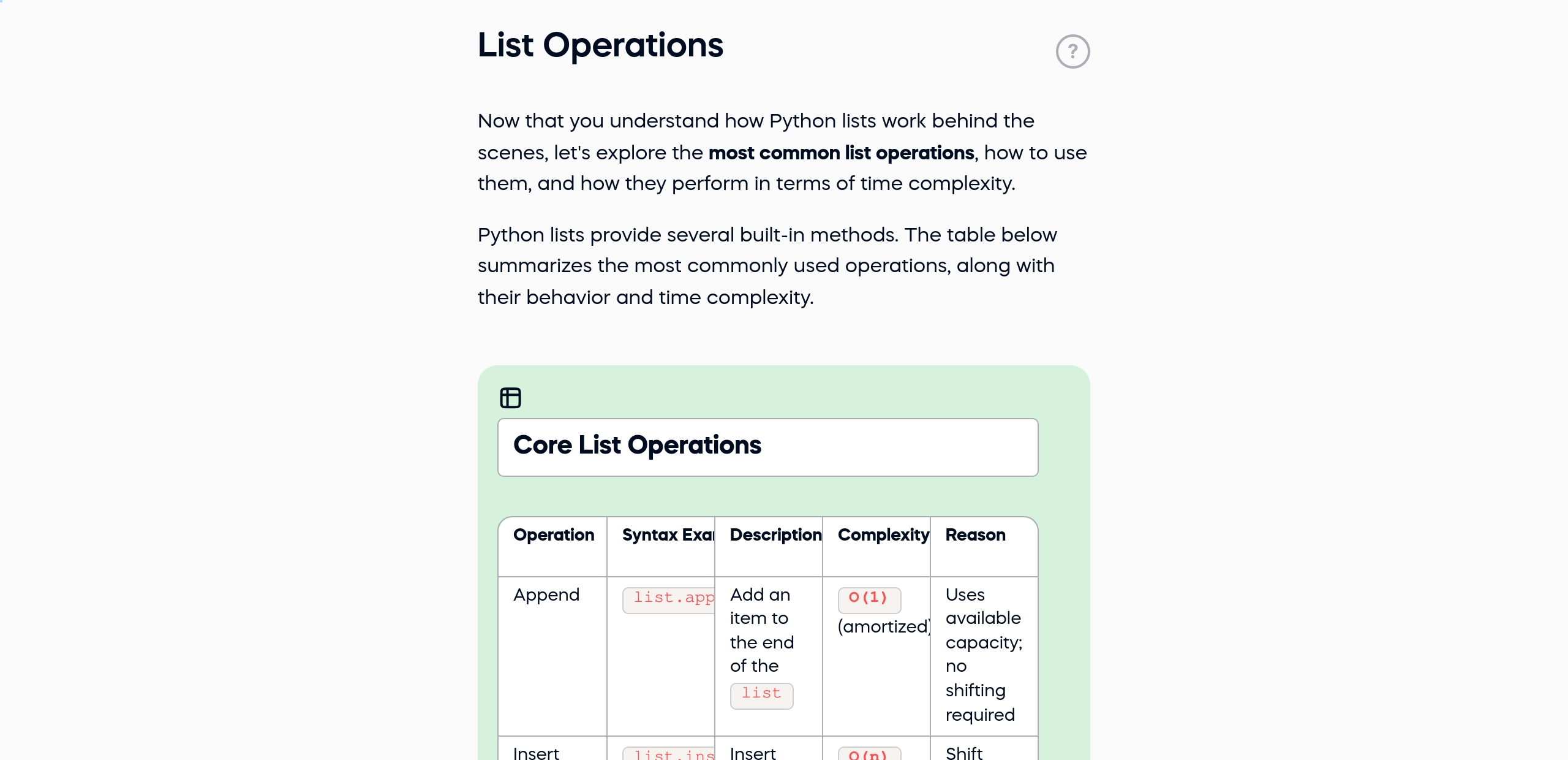
List Operations

2.7 List Operations

4 min

Real-World Applications

2.10 Real-World Applications

3 min

Start for free

$29,000

average salary increase

after moving to an AI and data science career

96%

of our students recommend

365 Data Science.

94%

of AI and data science graduates

successfully change

or advance their careers.

ACCREDITED certificates

Craft a resume and LinkedIn profile you’re proud of—featuring certificates recognized by leading global institutions.

Earn CPE-accredited credentials that showcase your dedication, growth, and essential skills—the qualities employers value most.

  • Institute of Analytics
  • E-Learning Quality Network
  • European Agency for Higher Education and Accreditation
  • Global Association of Online Trainers and Examiners

Certificates are included with the Self-study learning plan.
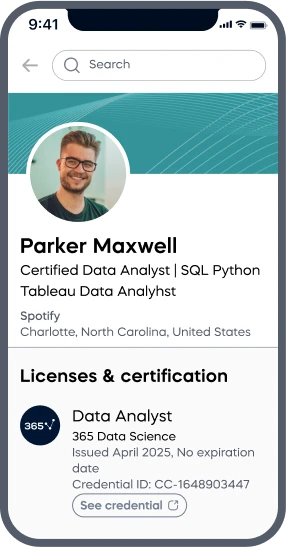
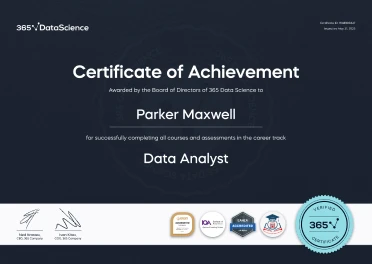
A LinkedIn profile mockup on a mobile screen showing Parker Maxwell, a Certified Data Analyst, with credentials from 365 Data Science listed under Licenses & Certification. A 365 Data Science Certificate of Achievement awarded to Parker Maxwell for completing the Data Analyst career track, featuring accreditation badges and a gold “Verified Certificate” seal.

How it WORKS

  • Lessons
  • Exercises
  • Projects
  • Practice exams
  • AI mock interviews

Lessons

Learn through short, simple lessons—no prior experience in AI or data science needed.

Try for free

Exercises

Reinforce your learning with mini recaps, hands-on coding, flashcards, fill-in-the-blank activities, and other engaging exercises.

Try for free

Projects

Tackle real-world AI and data science projects—just like those faced by industry professionals every day.

Try for free

Practice exams

Track your progress and solidify your knowledge with regular practice exams.

Try for free

AI mock interviews

Prep for interviews with real-world tasks, popular questions, and real-time feedback.

Try for free

Student REVIEWS

A collage of student testimonials from 365 Data Science learners, featuring profile photos, names, job titles, and quotes or video play icons, showcasing diverse backgrounds and successful career transitions into AI and data science roles.