Online Course
Math for Finance

Master financial mathematics: apply key mathematical techniques for improved financial decision-making

4.8

865 reviews on
12,137 students already enrolled
  • Institute of Analytics
  • The Association of Data Scientists
  • E-Learning Quality Network
  • European Agency for Higher Education and Accreditation
  • Global Association of Online Trainers and Examiners

Skill level:

Basic

Duration:

3 hours
  • Lessons (3 hours)
  • Practice exams (20 minutes)
  • Projects (2 hours)

CPE credits:

6
CPE stands for Continuing Professional Education and represents the mandatory credits a wide range of professionals must earn to maintain their licenses and stay current with regulations and best practices. One CPE credit typically equals 50 minutes of learning. For more details, visit NASBA's official website: www.nasbaregistry.org

Accredited

certificate

What you learn

  • Identify the key principle of the time value of money
  • Differentiate between the core components that determine bank interest rates
  • Compare present and future cash flows to make informed financial decisions
  • Calculate investment returns
  • Use advanced tools such as Net Present Value (NPV) and Internal Rate of Return
  • Apply financial math concepts such as discounting, compounding, and annuities

Topics & tools

ValuationFinancial AnalysisFinancial ModelingFinance FundamentalsDCFExcelCorporate FinanceTheoryFinancial MathFinance Theory

Your instructor

Course OVERVIEW

Description

CPE Credits: 6 Field of Study: Finance
Delivery Method: QAS Self Study
Math is a critical skill for any successful financial analyst. Much of the work entails evaluating capital projects and selecting investments. To carry out these tasks accurately, you must understand the mathematics behind time value of money problems. In this Math for Finance course, you will learn critical mathematical concepts required for a career in financial analysis, corporate finance, investment banking, risk management, private equity, financial planning and analysis, and many more. You will learn about the time value of money and why money is more valuable today than tomorrow. We also introduce the concept of interest rates and examine the premiums that compensate investors for bearing risk. By the end of the financial mathematics course, you will know how to solve time value of money problems in Excel for different frequencies of compounding. You will also learn to calculate and interpret the future and the present value of a single sum of money, an ordinary or annuity due, perpetuity, and a series of unequal cash flows. We explain the differences between the effective and annual interest rates, the importance of compounding frequency, and how it affects the future and the present value of our investments. Next, the finance mathematics course covers two of the most common metrics for estimating capital budgeting projects’ profitability: the Net Present Value (NPV) and the Internal Rate of Return (IRR). We contrast the two measures and identify problems associated with the IRR rule. Then, we introduce the most common investment and portfolio return measures: the Holding Period Return and the Money-Weighted and Time-Weighted Rate of Return. Our Math for Finance course also touches on several fixed income investment topics, such as bond valuation and yields. You will learn how to calculate the most common yield measures—current yield and yield to maturity. We also introduce the most important Excel functions that you need to calculate them. Lastly, we examine the different money market instruments and their specific yield measures, such as the money market, effective annual, and bond equivalent yields. Math for Finance is the must-have course for anyone looking to excel in finance. It covers key mathematical concepts and their real-world applications, equipping you with the knowledge to understand financial markets and make informed investment decisions. Whether you're a student or a seasoned professional, this course will give you a competitive edge. Enroll today and master the math behind financial markets.

Prerequisites

  • A basic knowledge of high school math is necessary to follow along with the course

Advanced preparation

  • None

Curriculum

40 lessons 46 exercises 1 project 2 exams
  • 1. The Time Value of Money
    27 min
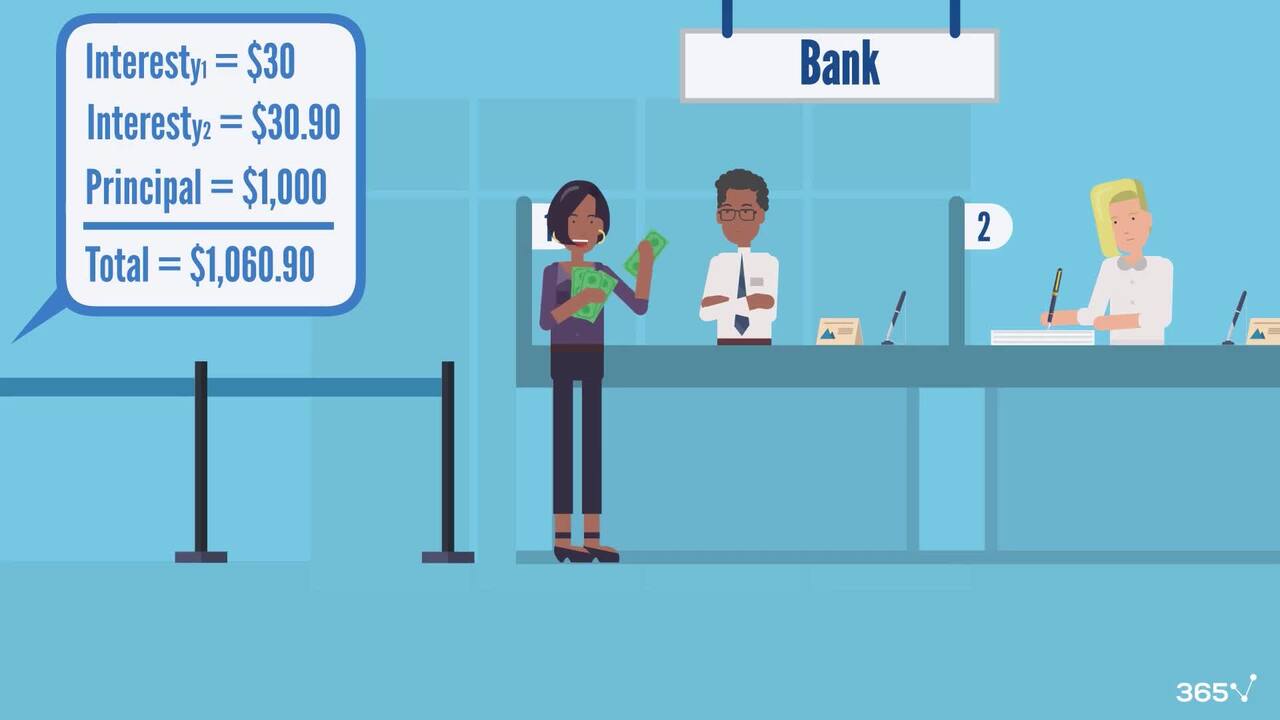
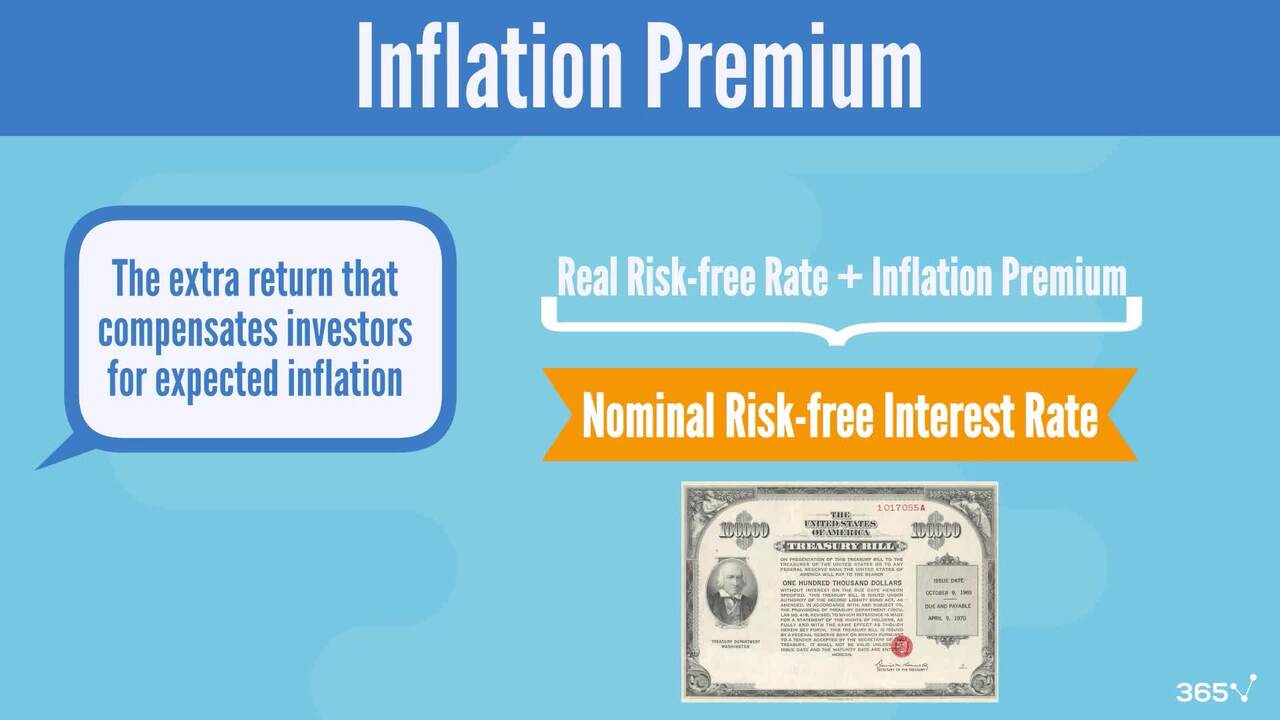
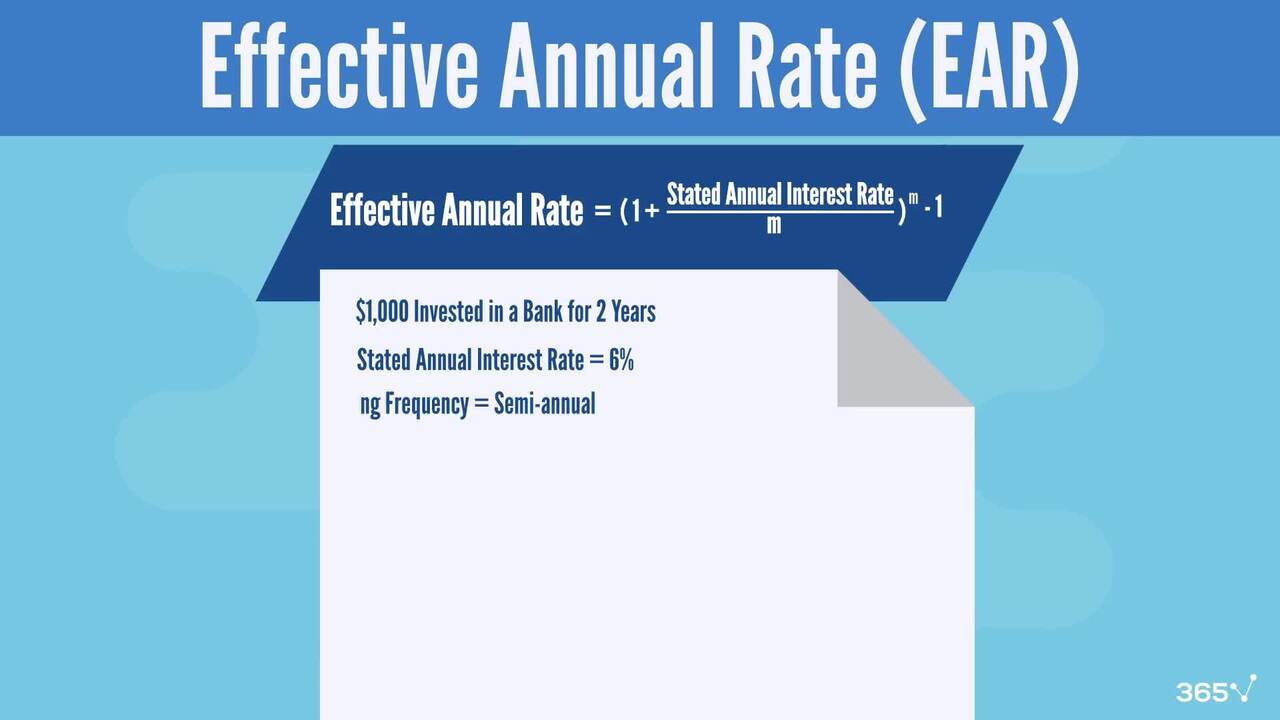
    In the introductory section, we discuss the time value of money and the core principle of finance—money today is more valuable than money tomorrow. You will learn how to interpret interest rates and decompose them as the sum of a real risk-free rate and different risk premiums. Finally, we calculate the effective annual rate (EAR) by incorporating the effects of compounding.
    27 min
    In the introductory section, we discuss the time value of money and the core principle of finance—money today is more valuable than money tomorrow. You will learn how to interpret interest rates and decompose them as the sum of a real risk-free rate and different risk premiums. Finally, we calculate the effective annual rate (EAR) by incorporating the effects of compounding.
    Course Guide and Syllabus
    Course Introduction Free
    Time Value of Money (Key Concepts) Free
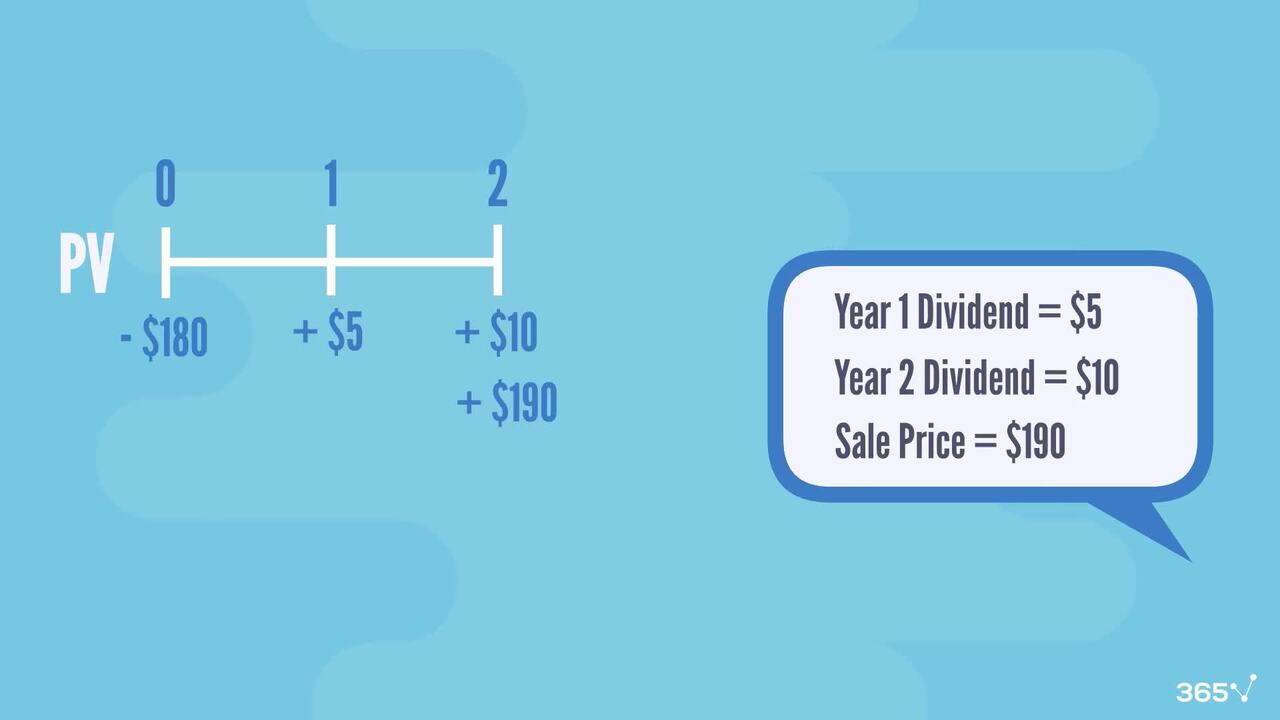
    The Timeline Free
    Interest Rate (Interpretations)
    Interest Rate (Components)
    The Effective Annual Rate (EAR)
    Exercise
  • 2. Moving Money Through Time
    39 min
    In this section of the financial mathematics course, we examine the relationship between present and future value and learn how to move money through time. We discuss the importance of compounding frequency, how it affects the present and future value of our investments, and the different types of cash flow streams. Lastly, you will learn how to calculate the future and the present value of ordinary and annuity due and unequal cash flows.
    39 min
    In this section of the financial mathematics course, we examine the relationship between present and future value and learn how to move money through time. We discuss the importance of compounding frequency, how it affects the present and future value of our investments, and the different types of cash flow streams. Lastly, you will learn how to calculate the future and the present value of ordinary and annuity due and unequal cash flows.
    Section 2: Learning Objectives
    The Relationship Between PV and FV
    Moving Money Through Time
    The Effect Of Compounding Frequency
    Exercise
    Ordinary Annuity
    Annuity Due
    Perpetuity
    Growing Perpetuity
    FV and PV Of Unequal Cash Flows
    Exercise
  • 3. Modeling and Solving Time Value of Money Problems
    21 min
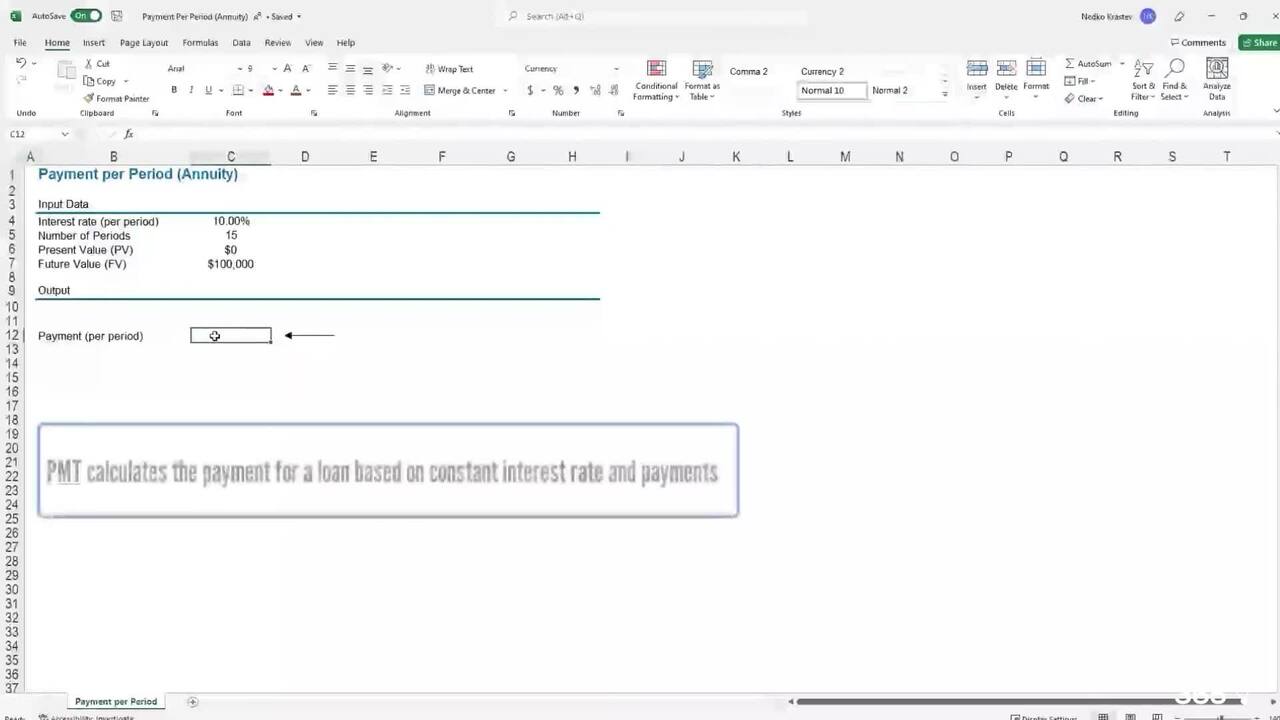
    In this core section of the Math for Finance course, you will learn to model and solve time value of money problems. We show you how to obtain the size of annuity payments manually and in Excel. You will learn how to calculate the number of years it takes to reach your financial goal and find investments' growth rates. At the end of this section, we examine the cash flow additivity principle.
    21 min
    In this core section of the Math for Finance course, you will learn to model and solve time value of money problems. We show you how to obtain the size of annuity payments manually and in Excel. You will learn how to calculate the number of years it takes to reach your financial goal and find investments' growth rates. At the end of this section, we examine the cash flow additivity principle.
    Section 3: Learning Objectives
    Solving for the Size of Annuity Payments
    Calculate the Number of Years It Takes to Reach Your Financial Goal
    What Is The Rate Of Return On My Investment
    The Cash Flow Additivity Principle
    Exercise
  • 4. NPV and IRR
    34 min
    Having covered interest rates, we can discuss several discounted cash flow applications. In this practical section, we introduce the Net Present Value and Internal Rate of Return techniques. They help us determine whether a project is feasible and advantageous from a financial perspective. Finally, you will learn how to choose the most profitable project when the two measures produce conflicting results.
    34 min
    Having covered interest rates, we can discuss several discounted cash flow applications. In this practical section, we introduce the Net Present Value and Internal Rate of Return techniques. They help us determine whether a project is feasible and advantageous from a financial perspective. Finally, you will learn how to choose the most profitable project when the two measures produce conflicting results.
    Section 4: Learning Objectives
    Net Present Value (NPV)
    Net Present Value (Calculation)
    Internal Rate of Return (IRR)
    NPV vs IRR
    Exercise
  • 5. Return Measures
    27 min
    This section of the finance mathematics course is dedicated to the different return measures. First, we examine the holding period yield, the logarithmic return, and the differences between them. Then, we explore the two most common portfolio return measurements: the Money-Weighted Rate of Return and the Time-Weighted Rate of Return.
    27 min
    This section of the finance mathematics course is dedicated to the different return measures. First, we examine the holding period yield, the logarithmic return, and the differences between them. Then, we explore the two most common portfolio return measurements: the Money-Weighted Rate of Return and the Time-Weighted Rate of Return.
    Section 5: Learning Objectives
    The holding period return
    Log Return
    Arithmetic vs Geometric Mean Return
    Money-weighted rate of return
    Time-weighted rate of return
    Exercise
  • 6. Bond Pricing and Yields
    42 min
    In the final section of the Math for Finance course, we discuss bond pricing and yields. You will learn how to calculate yield measures, such as current yield and yield to maturity, and determine whether a bond trades at a discount, par, or premium. At the end of this section, we examine the short-term debt market. You will learn how to calculate different money market yields, such as the bank discount, effective annual, and money market yields.
    42 min
    In the final section of the Math for Finance course, we discuss bond pricing and yields. You will learn how to calculate yield measures, such as current yield and yield to maturity, and determine whether a bond trades at a discount, par, or premium. At the end of this section, we examine the short-term debt market. You will learn how to calculate different money market yields, such as the bank discount, effective annual, and money market yields.
    Section 6: Learning Objectives
    Introduction
    Par Value
    Valuing a Bond
    Bond Yield
    Bank Discount Yield
    Money Market Instruments (Yield Measures)
    Yield Measures (Conversion)
    Exercise
  • 7. Course project and exam
    168 min
    168 min
    Applied Financial Math for Decision-Making Project Free
    Course exam

Free lessons

Course Introduction

1.2 Course Introduction

3 min

Time Value of Money (Key Concepts)

1.3 Time Value of Money (Key Concepts)

5 min

The Timeline

1.4 The Timeline

3 min

Interest Rate (Interpretations)

1.5 Interest Rate (Interpretations)

3 min

Interest Rate (Components)

1.6 Interest Rate (Components)

5 min

The Effective Annual Rate (EAR)

1.7 The Effective Annual Rate (EAR)

3 min

Start for free

96%

of our students recommend

365 Data Science.

94%

of AI and data science graduates

successfully change

or advance their careers.

9 in 10

people walk away career-ready

with practical data and AI skills.

ACCREDITED certificates

Craft a resume and LinkedIn profile you’re proud of—featuring certificates recognized by leading global institutions.

Earn CPE-accredited credentials that showcase your dedication, growth, and essential skills—the qualities employers value most.

  • Institute of Analytics
  • The Association of Data Scientists
  • E-Learning Quality Network
  • European Agency for Higher Education and Accreditation
  • Global Association of Online Trainers and Examiners

Certificates are included with the Self-study learning plan.

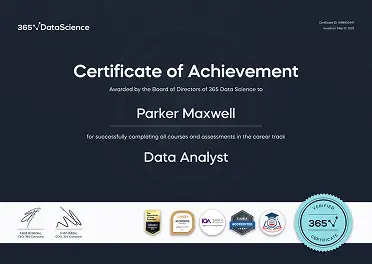
A LinkedIn profile mockup on a mobile screen showing Parker Maxwell, a Certified Data Analyst, with credentials from 365 Data Science listed under Licenses & Certification. A 365 Data Science Certificate of Achievement awarded to Parker Maxwell for completing the Data Analyst career track, featuring accreditation badges and a gold “Verified Certificate” seal.

How it WORKS

  • Lessons
  • Exercises
  • Projects
  • Practice exams
  • AI mock interviews

Lessons

Learn through short, simple lessons—no prior experience in AI or data science needed.

Try for free

Exercises

Reinforce your learning with mini recaps, hands-on coding, flashcards, fill-in-the-blank activities, and other engaging exercises.

Try for free

Projects

Tackle real-world AI and data science projects—just like those faced by industry professionals every day.

Try for free

Practice exams

Track your progress and solidify your knowledge with regular practice exams.

Try for free

AI mock interviews

Prep for interviews with real-world tasks, popular questions, and real-time feedback.

Try for free

Student REVIEWS

A collage of student testimonials from 365 Data Science learners, featuring profile photos, names, job titles, and quotes or video play icons, showcasing diverse backgrounds and successful career transitions into AI and data science roles.