Online Course trending topic
Intro to Data Engineering

Get an introduction to the data engineering field and the career opportunities it offers. Enhance your resume with essential data engineering skills

4.9

808 reviews on
5835 students already enrolled
  • Institute of Analytics
  • The Association of Data Scientists
  • E-Learning Quality Network
  • European Agency for Higher Education and Accreditation
  • Global Association of Online Trainers and Examiners

Skill level:

Basic

Duration:

4 hours
  • Lessons (4 hours)

CPE credits:

4.5
CPE stands for Continuing Professional Education and represents the mandatory credits a wide range of professionals must earn to maintain their licenses and stay current with regulations and best practices. One CPE credit typically equals 50 minutes of learning. For more details, visit NASBA's official website: www.nasbaregistry.org

Accredited

certificate

What you learn

  • Discover the data engineering field and its career opportunities.
  • Learn data engineering fundamentals and core concepts.
  • Determine if data engineering is the right career fit for you.
  • Learn how to enhance data processes at your company.
  • Acquire practical technical skills and prepare for interviews.

Topics & tools

Data EngineeringCareer DevelopmentTheory

Your instructor

Course OVERVIEW

Description

CPE Credits: 4.5 Field of Study: Information Technology
Delivery Method: QAS Self Study
Do you want to get an intro to data engineering? Are you interested in becoming a data engineer? If that’s the case, then our Intro to Data Engineering course is the perfect fit for you. Learn data engineering from course instructor Shashank Kalanithi, who has rich experience in the data and tech field. He has held roles as a data analyst, data scientist, data engineer, and currently works as a software engineer at Meta. Shashank is passionate about teaching and is eager to pass on his experience to you. His engaging teaching style combined with his notable professional experience make him the perfect tutor for you. If you’re unfamiliar with the field, you might ask ‘what does a data engineer do’? A data engineer designs, builds, and maintains systems for collecting, storing, and analyzing data. Our data engineering course is perfect for people who are looking into a career in data engineering, as well as for those who have already landed a data engineering job but are still in the early days of their journey. Why is this the perfect course for data newcomers? - Determine if data engineering is a career path that interests you - Understand the difference between common roles: data analyst vs data scientist vs data engineer vs software engineer (note: data engineering skills allow you to transition to any of the other roles as you advance in your career) - Learn fundamental data engineering concepts, how to become a data engineer, and how to land your first job Why is this the perfect course for entry level data engineers? - Gain a big picture understanding of the data engineering field and its requirements - Benefit from Shashank's years of experience and gain valuable insights to excel in your job - Understand the different paths you can take in your career progression - Discover methods to enhance data engineering processes within your company What’s included in our data engineer training? Intro to Data Engineering begins with an overview of the data engineering career path. You will learn about the data engineering role, the technical skills needed on the job, and the different potential paths for career development. Then, you will learn about data architecture—a critical topic in data engineering. This field involves creating a structured framework for managing data. You'll also explore data orchestration, which is the automation of the flow and processing of data across different systems. Our data engineering course also covers relational databases, non-relational databases, and the software engineering skills required for data engineering. You will learn about crucial data engineering tools and frameworks like SQL, NoSQL, Python, APIs, Version Control, Docker and Containerization, Hadoop, Spark, Kafka, and more. Finally, Shashank will wrap up the Intro to Data Engineering course with insights on important aspects like data security and privacy. We hope you are very excited about this course! Start your data engineering journey today!

Prerequisites

  • Basic understanding of data concepts (such as databases, tables, and files) is helpful but not required.


Advanced preparation

  • None

Curriculum

47 lessons 1 exam
  • 1. Introduction
    3 min
    Get an introduction to the course author and learn how the "Intro to Data Engineering" course will boost your career.
    3 min
    Get an introduction to the course author and learn how the "Intro to Data Engineering" course will boost your career.
  • 2. Data Engineering Career
    46 min
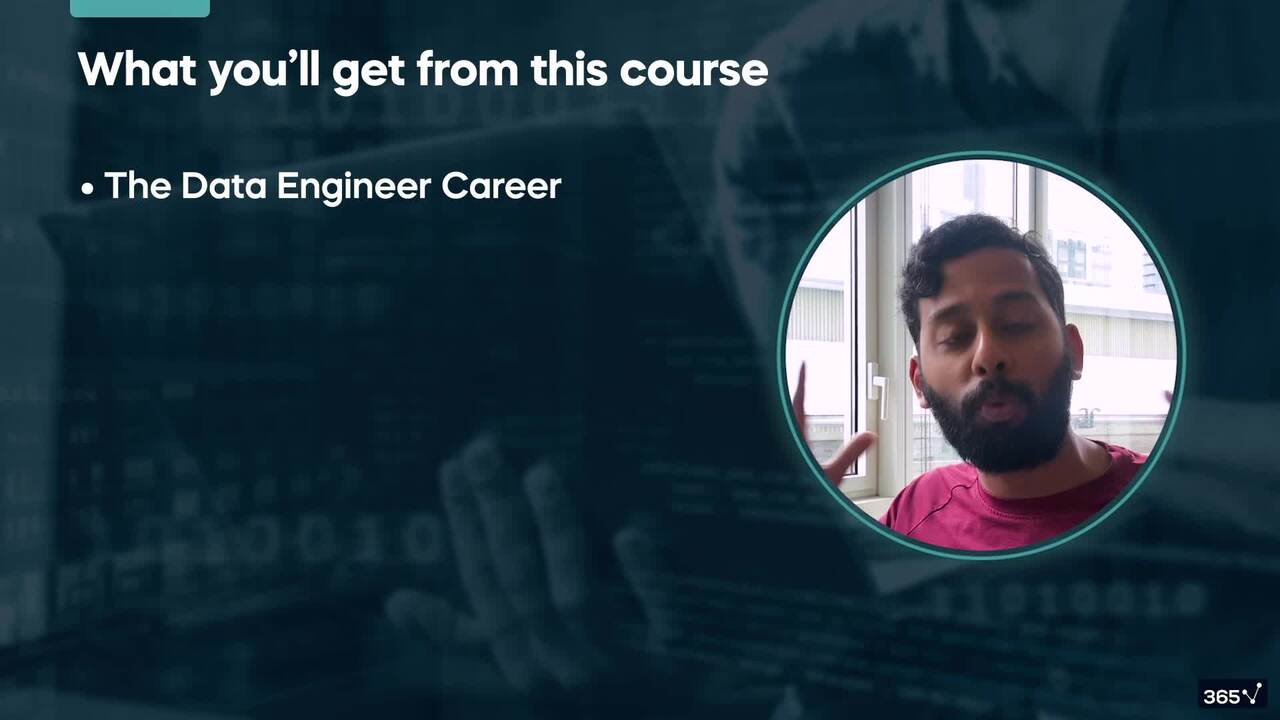
    In this section of the course, you will learn what a data engineer is, the different data engineering lifecycles, and the career paths related to data engineering. Shashank Kalanithi offers a comprehensive comparison to other data science and software engineering professions, allowing you to understand how data engineers contribute to an engineering team and what precisely their role is.
    46 min
    In this section of the course, you will learn what a data engineer is, the different data engineering lifecycles, and the career paths related to data engineering. Shashank Kalanithi offers a comprehensive comparison to other data science and software engineering professions, allowing you to understand how data engineers contribute to an engineering team and what precisely their role is.
  • 3. Data Architecture
    55 min
    This part of the course introduces the concept of data architecture, its uses, and its implementation as a data engineer. Data architecture is the overarching structure and design principles guiding the collection, storage, management, and use of data within an organization.
    55 min
    This part of the course introduces the concept of data architecture, its uses, and its implementation as a data engineer. Data architecture is the overarching structure and design principles guiding the collection, storage, management, and use of data within an organization.
  • 4. Data Orchestration
    14 min
    Data orchestration helps us coordinate, schedule, and run data workflows. Get an introduction to how companies use tools like Apache Airflow for their data orchestration needs.
    14 min
    Data orchestration helps us coordinate, schedule, and run data workflows. Get an introduction to how companies use tools like Apache Airflow for their data orchestration needs.
  • 5. Relational Databases
    19 min
    Relational databases are the core aspect around which most data engineering work revolves. Every data engineering job will have you interacting with relational databases.
    19 min
    Relational databases are the core aspect around which most data engineering work revolves. Every data engineering job will have you interacting with relational databases.
  • 6. Non-relational Databases
    21 min
    NoSQL databases are designed to handle large volumes of structured, semi-structured, and unstructured data, providing flexible schemas and scalability that traditional relational databases lack. Learning about NoSQL is essential because it equips you with the skills to manage and analyze diverse data types efficiently in modern big data environments.
    21 min
    NoSQL databases are designed to handle large volumes of structured, semi-structured, and unstructured data, providing flexible schemas and scalability that traditional relational databases lack. Learning about NoSQL is essential because it equips you with the skills to manage and analyze diverse data types efficiently in modern big data environments.
  • 7. Software Engineering
    34 min
    This section of the course covers crucial software engineering aspects necessary for effective data engineering. You'll learn about scaling techniques (horizontal vs. vertical), use Python for scripting and automation, interface with APIs, manage tasks using shell scripting and cron, maintain versions with tools like Git and Mercurial, ensure code quality through testing, deploy applications using Docker, and manage infrastructure efficiently. These skills are foundational for building and maintaining scalable and robust data processing systems.
    34 min
    This section of the course covers crucial software engineering aspects necessary for effective data engineering. You'll learn about scaling techniques (horizontal vs. vertical), use Python for scripting and automation, interface with APIs, manage tasks using shell scripting and cron, maintain versions with tools like Git and Mercurial, ensure code quality through testing, deploy applications using Docker, and manage infrastructure efficiently. These skills are foundational for building and maintaining scalable and robust data processing systems.
  • 8. Big Data Engineering
    11 min
    In this part of the course, we will go over some of the larger concepts you have heard of and will provide a foundational understanding of what big data is. However, we will not go into too much detail because very few companies need to use these technologies at the scale required by Big Tech companies.
    11 min
    In this part of the course, we will go over some of the larger concepts you have heard of and will provide a foundational understanding of what big data is. However, we will not go into too much detail because very few companies need to use these technologies at the scale required by Big Tech companies.
  • 9. Data Modeling
    15 min
    This section delves into Data Modeling, a cornerstone of data engineering that ensures structured and efficient data storage and retrieval. You'll explore the transformation from logical to physical data models, entity-relationship diagrams, normalization principles for database optimization, and the Kimball and Inmon approaches to data warehousing.
    15 min
    This section delves into Data Modeling, a cornerstone of data engineering that ensures structured and efficient data storage and retrieval. You'll explore the transformation from logical to physical data models, entity-relationship diagrams, normalization principles for database optimization, and the Kimball and Inmon approaches to data warehousing.
  • 10. Security and Privacy
    8 min
    The concluding lessons of the Intro to Data Engineering course underscore the critical importance of security and privacy in data engineering. You will learn core principles related to how to minimize access rights for users, accounts, and computing processes to only those resources absolutely necessary for their functions, in an effort to enhance overall system security.
    8 min
    The concluding lessons of the Intro to Data Engineering course underscore the critical importance of security and privacy in data engineering. You will learn core principles related to how to minimize access rights for users, accounts, and computing processes to only those resources absolutely necessary for their functions, in an effort to enhance overall system security.
  • 11. Course exam
    30 min
    30 min

Free lessons

What will this course teach you

1.1 What will this course teach you

3 min

What is a Data Engineer?

2.1 What is a Data Engineer?

7 min

Data Engineering lifecycle

2.2 Data Engineering lifecycle

8 min

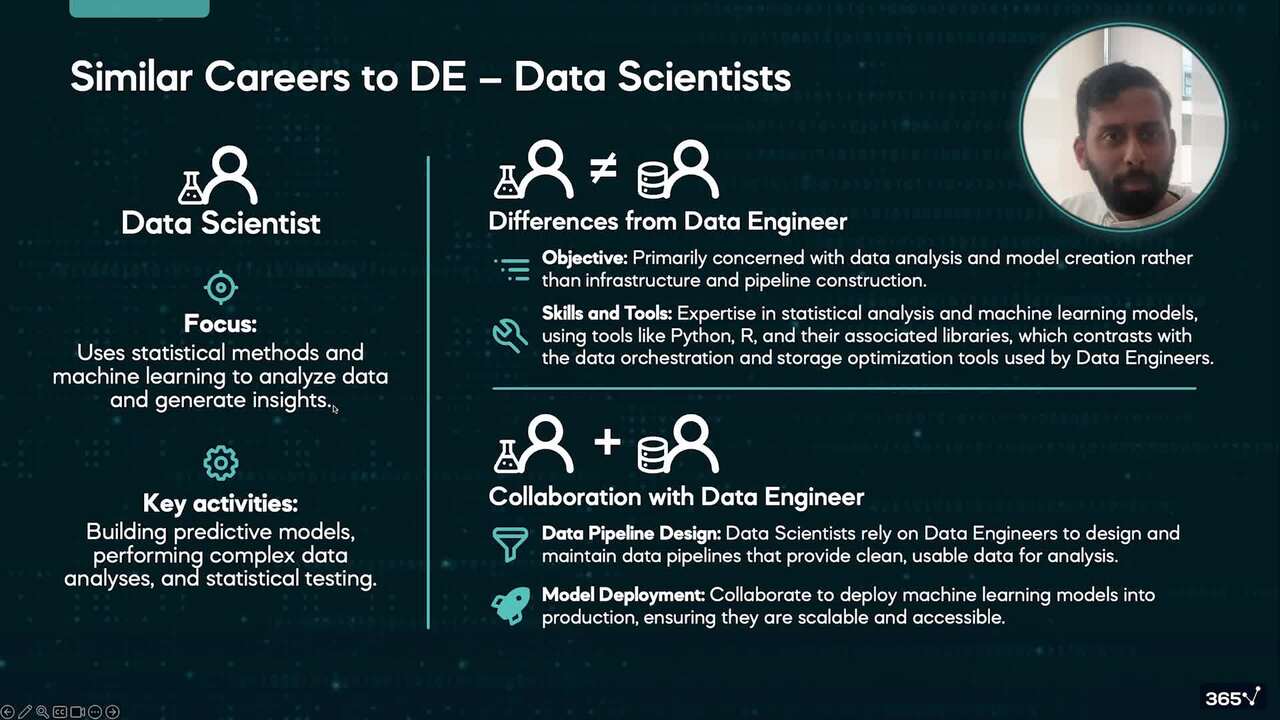
Similar careers to Data Engineering

2.3 Similar careers to Data Engineering

9 min

Data Engineering service models

2.4 Data Engineering service models

7 min

Data Engineer leveling guide

2.5 Data Engineer leveling guide

10 min

Start for free

9 in 10

of our graduates landed a new AI & data job

after enrollment

4.9

Based on 808 reviews

#1 most reviewed

AI and data learning platform on Trustpilot.

9 in 10

people walk away career-ready

with practical data and AI skills.

ACCREDITED certificates

Craft a resume and LinkedIn profile you’re proud of—featuring certificates recognized by leading global institutions.

Earn CPE-accredited credentials that showcase your dedication, growth, and essential skills—the qualities employers value most.

  • Institute of Analytics
  • The Association of Data Scientists
  • E-Learning Quality Network
  • European Agency for Higher Education and Accreditation
  • Global Association of Online Trainers and Examiners

Certificates are included with the Self-Study learning plan.

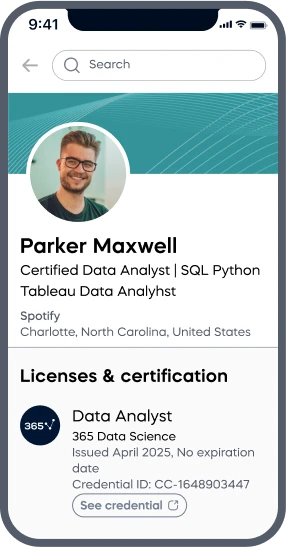
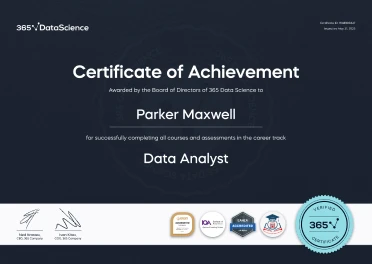
A LinkedIn profile mockup on a mobile screen showing Parker Maxwell, a Certified Data Analyst, with credentials from 365 Data Science listed under Licenses & Certification. A 365 Data Science Certificate of Achievement awarded to Parker Maxwell for completing the Data Analyst career track, featuring accreditation badges and a gold “Verified Certificate” seal.

How it WORKS

  • Lessons
  • Exercises
  • Projects
  • Practice exams
  • AI mock interviews

Lessons

Learn through short, simple lessons—no prior experience in AI or data science needed.

Try for free

Exercises

Reinforce your learning with mini recaps, hands-on coding, flashcards, fill-in-the-blank activities, and other engaging exercises.

Try for free

Projects

Tackle real-world AI and data science projects—just like those faced by industry professionals every day.

Try for free

Practice exams

Track your progress and solidify your knowledge with regular practice exams.

Try for free

AI mock interviews

Prep for interviews with real-world tasks, popular questions, and real-time feedback.

Try for free

Student REVIEWS

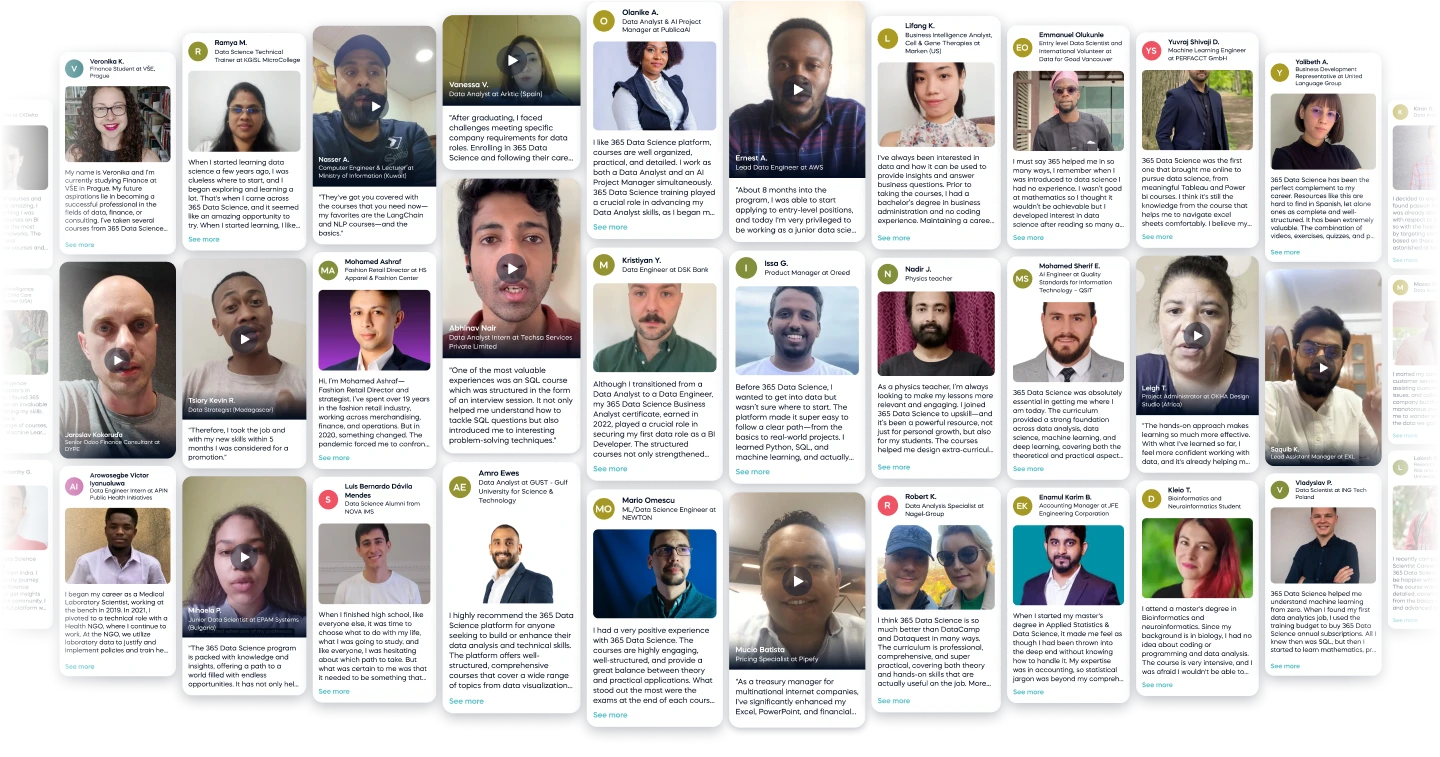
A collage of student testimonials from 365 Data Science learners, featuring profile photos, names, job titles, and quotes or video play icons, showcasing diverse backgrounds and successful career transitions into AI and data science roles.