Online Course
Intermediate Python Programming

Boost your Python programming skills: Learn advanced text manipulation and efficient coding techniques

4.8

862 reviews on
7,149 students already enrolled
  • Institute of Analytics
  • The Association of Data Scientists
  • E-Learning Quality Network
  • European Agency for Higher Education and Accreditation
  • Global Association of Online Trainers and Examiners

Skill level:

Intermediate

Duration:

1 hour
  • Lessons (1 hour)
  • Practice exams (10 minutes)

CPE credits:

1.5
CPE stands for Continuing Professional Education and represents the mandatory credits a wide range of professionals must earn to maintain their licenses and stay current with regulations and best practices. One CPE credit typically equals 50 minutes of learning. For more details, visit NASBA's official website: www.nasbaregistry.org

Accredited

certificate

What you learn

  • Work with text data and argument specifiers effectively.
  • Use list comprehensions to write concise, efficient code.
  • Apply anonymous (lambda) functions to streamline your code.
  • Solve complex problems using multi-level iteration and nested loops.
  • Become a proficient Python programmer.

Topics & tools

JupyterProgrammingList ComprehensionsNested LoopsWorking with Text DataPythonAnonymous (Lambda) Functions

Your instructor

Course OVERVIEW

Description

CPE Credits: 1.5 Field of Study: Information Technology
Delivery Method: QAS Self Study
This course is short yet intense. We assume you’re no stranger to Jupyter and Python fundamentals, such as conditionals, functions, sequences, and iterations. Nevertheless, a lack of experience working with text data, list comprehensions, and anonymous (Lambda) functions would immediately reveal to your data science colleagues that coding in Python hasn’t become second nature. In the following sections, we explain these intermediate programming tools in detail and provide an extensive set of exercises to ensure your ability to comply with today’s best practices in the field.

Prerequisites

  • Python (any recent version, such as Python 3.8 or later) and a code editor or IDE (e.g., Spyder, VS Code, or Jupyter Notebook)
  • Completion of an introductory Python course is recommended.

Advanced preparation

Curriculum

13 lessons 11 exercises 2 exams
  • 1. Intermediate Python Programming - Introduction
    5 min
    What are intermediate Python tools, and why do we need to learn and practice them?
    5 min
    What are intermediate Python tools, and why do we need to learn and practice them?
    Course Introduction Free
    Python Refresher and Setting Up the Environment
  • 2. Working with Text Data in Python
    41 min
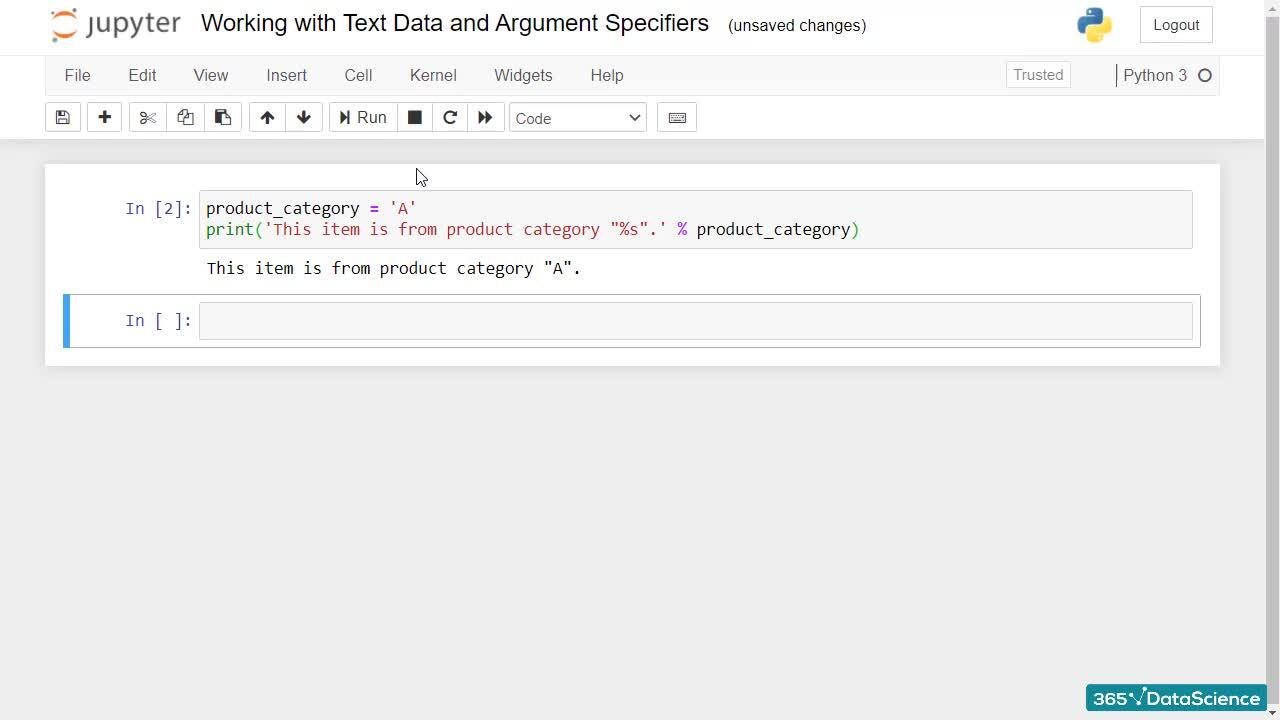
    Whether you use Python for general programming or analytics, you’ll not only manage quantitative data; you’ll also need to clean and preprocess vast amounts of text data. This section covers various tools—such as argument specifiers and string accessors—to help you manipulate text data. We’ll also work with widely-applicable Python string methods, such as .split(), .strip(), and .format().
    41 min
    Whether you use Python for general programming or analytics, you’ll not only manage quantitative data; you’ll also need to clean and preprocess vast amounts of text data. This section covers various tools—such as argument specifiers and string accessors—to help you manipulate text data. We’ll also work with widely-applicable Python string methods, such as .split(), .strip(), and .format().
    Dealing with Text Data and Argument Specifiers Free
    Coding exercise
    Working with Python Strings at the Next Level Free
    Coding exercise
    Exploring Python String Methods - Part I
    Coding exercise
    Exploring Python String Methods - Part II
    Coding exercise
    Learning How to Use String Accessors
    Coding exercise
    Working with the .format() Method
    Coding exercise
  • 3. Nested for Loops, List Comprehensions, and Anonymous Functions
    32 min
    Once accustomed to manipulating text data, doors will open for you to employ several tools that will optimize the use of iterations and functions to the highest level. You’ll learn and apply iteration over range objects, nested for loops, list comprehensions, and anonymous (Lambda) functions.
    32 min
    Once accustomed to manipulating text data, doors will open for you to employ several tools that will optimize the use of iterations and functions to the highest level. You’ll learn and apply iteration over range objects, nested for loops, list comprehensions, and anonymous (Lambda) functions.
    The Concept of Iterating Over Range Objects in Python Free
    Introduction to Nested For Loops
    Coding exercise
    Working with Triple Nested For Loops
    Coding exercise
    Using List Comprehensions
    Coding exercise
    Coding exercise
    Working with Anonymous (Lambda) Functions
    Coding exercise
    Practice exam
  • 4. Course exam
    13 min
    13 min
    Course exam

Free lessons

Course Introduction

1.1 Course Introduction

3 min

Dealing with Text Data and Argument Specifiers

2.1 Dealing with Text Data and Argument Specifiers

9 min
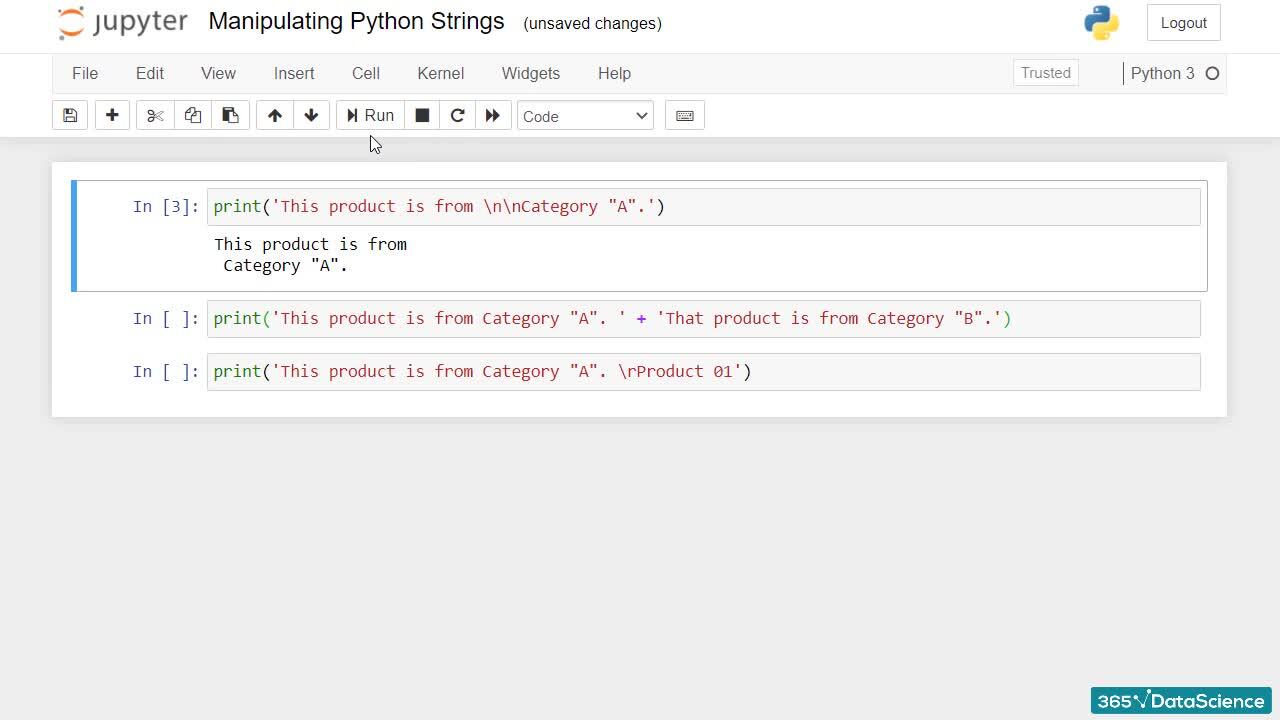
Working with Python Strings at the Next Level

2.3 Working with Python Strings at the Next Level

4 min
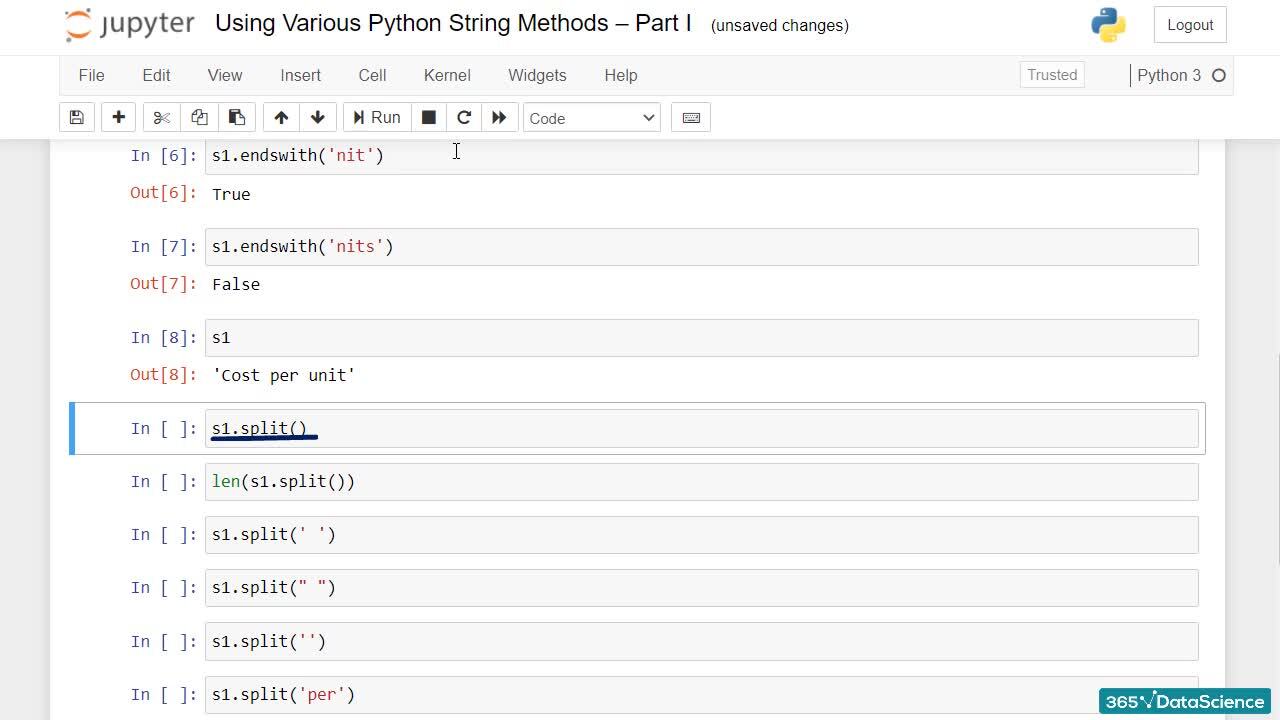
Exploring Python String Methods - Part I

2.5 Exploring Python String Methods - Part I

7 min
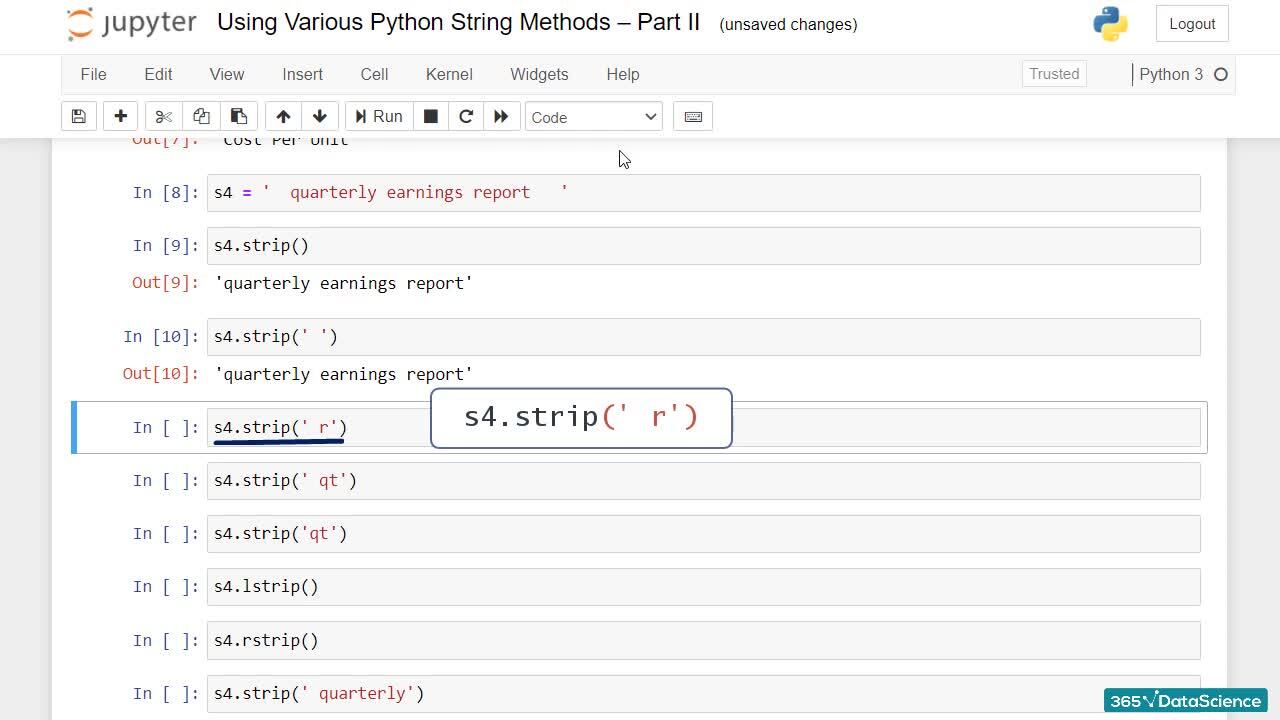
Exploring Python String Methods - Part II

2.7 Exploring Python String Methods - Part II

7 min
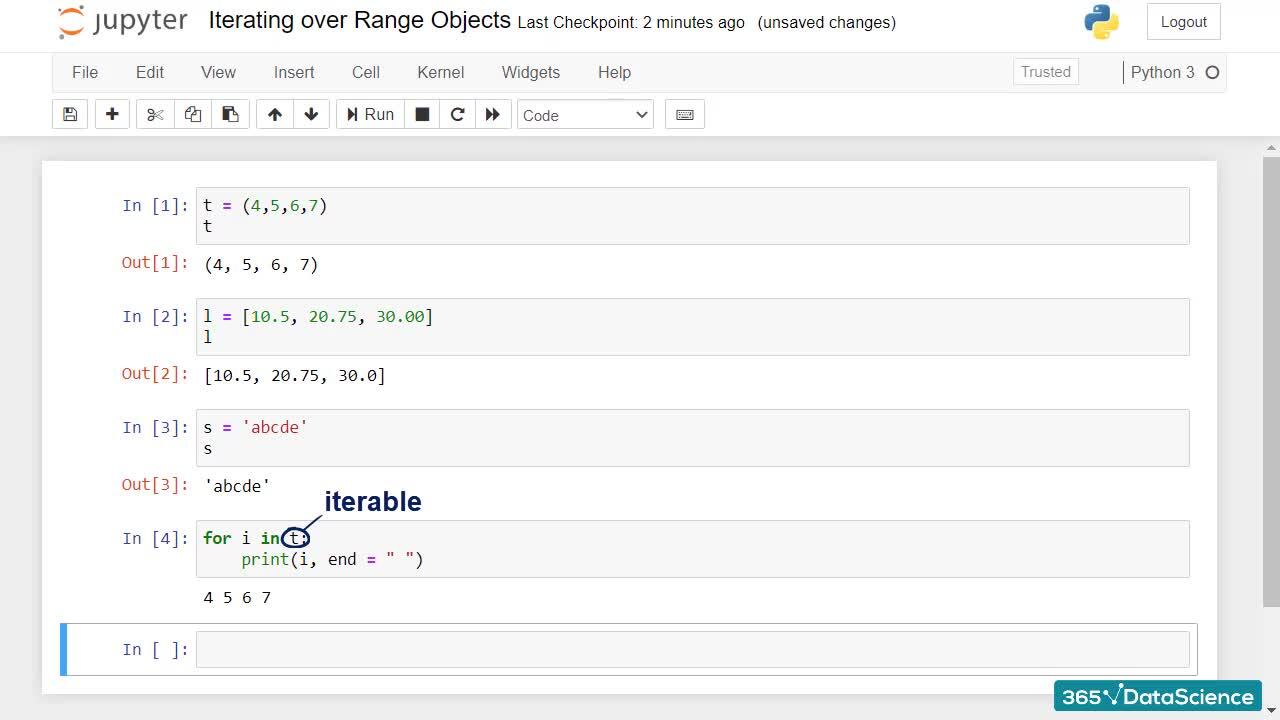
The Concept of Iterating Over Range Objects in Python

3.1 The Concept of Iterating Over Range Objects in Python

4 min

Start for free

96%

of our students recommend

365 Data Science.

9 in 10

people walk away career-ready

with practical data and AI skills.

94%

of AI and data science graduates

successfully change

or advance their careers.

ACCREDITED certificates

Craft a resume and LinkedIn profile you’re proud of—featuring certificates recognized by leading global institutions.

Earn CPE-accredited credentials that showcase your dedication, growth, and essential skills—the qualities employers value most.

  • Institute of Analytics
  • The Association of Data Scientists
  • E-Learning Quality Network
  • European Agency for Higher Education and Accreditation
  • Global Association of Online Trainers and Examiners

Certificates are included with the Self-study learning plan.
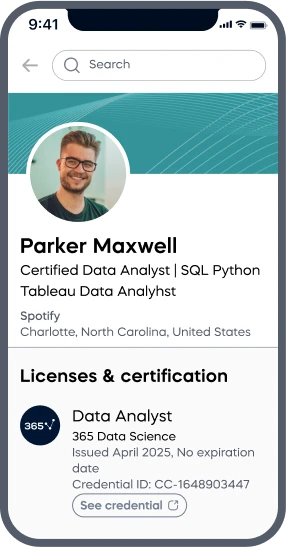
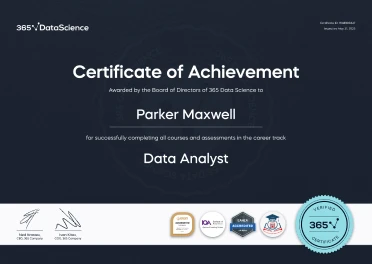
A LinkedIn profile mockup on a mobile screen showing Parker Maxwell, a Certified Data Analyst, with credentials from 365 Data Science listed under Licenses & Certification. A 365 Data Science Certificate of Achievement awarded to Parker Maxwell for completing the Data Analyst career track, featuring accreditation badges and a gold “Verified Certificate” seal.

How it WORKS

  • Lessons
  • Exercises
  • Projects
  • Practice exams
  • AI mock interviews

Lessons

Learn through short, simple lessons—no prior experience in AI or data science needed.

Try for free

Exercises

Reinforce your learning with mini recaps, hands-on coding, flashcards, fill-in-the-blank activities, and other engaging exercises.

Try for free

Projects

Tackle real-world AI and data science projects—just like those faced by industry professionals every day.

Try for free

Practice exams

Track your progress and solidify your knowledge with regular practice exams.

Try for free

AI mock interviews

Prep for interviews with real-world tasks, popular questions, and real-time feedback.

Try for free

Student REVIEWS

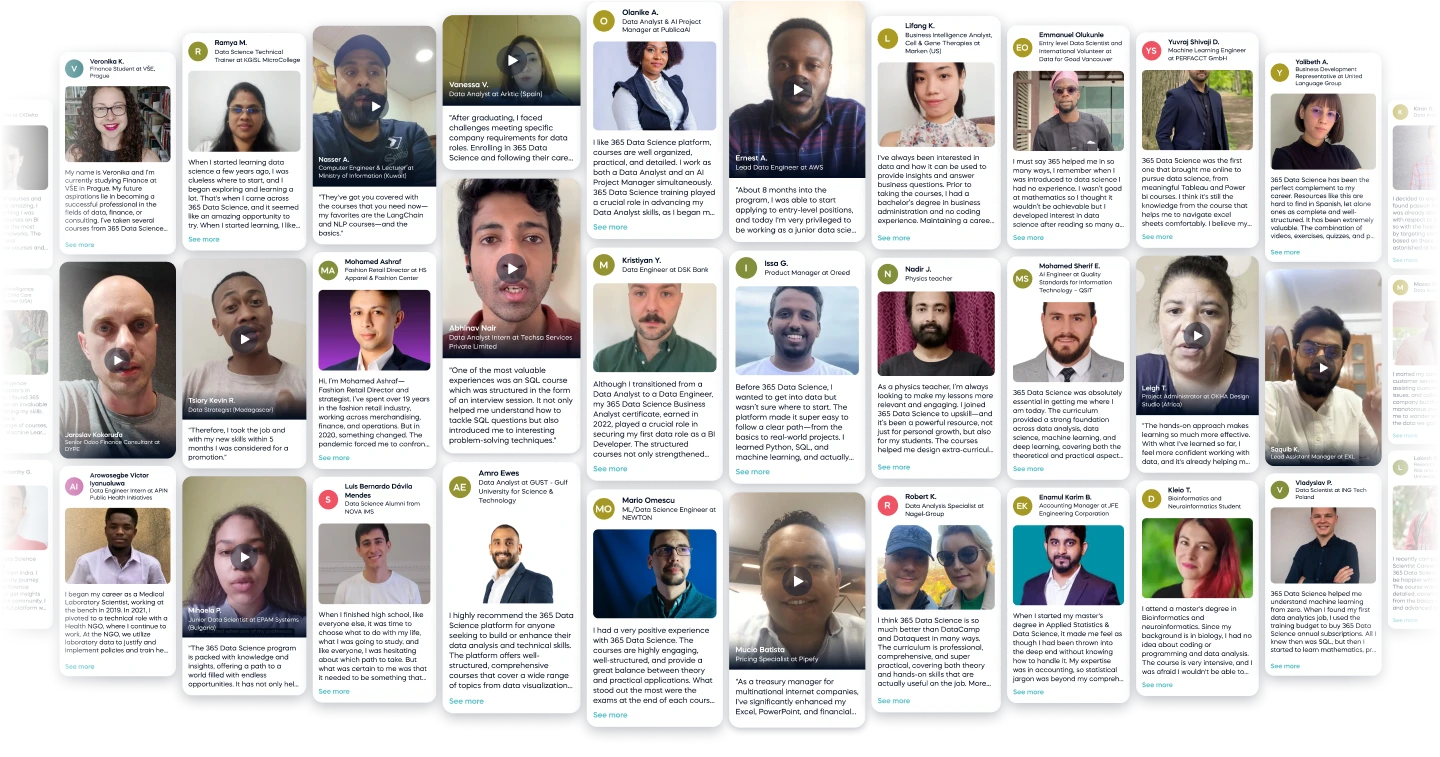
A collage of student testimonials from 365 Data Science learners, featuring profile photos, names, job titles, and quotes or video play icons, showcasing diverse backgrounds and successful career transitions into AI and data science roles.