Vanessa V.
After 365:
Analyst at Arctic Business Consulting
See all reviews
Master Apache Kafka for modern data engineering, real-time streaming, RAG, machine learning, and agentic AI





Skill level:
Duration:
CPE credits:
Accredited

Bringing real-world expertise from leading global companies


Master's degree, Data Science

Description
Apache Kafka has become the central nervous system of modern data engineering, powering the real-time movement of data across applications, analytics systems, and increasingly, AI infrastructure.
This course gives you a strong conceptual and practical foundation in Apache Kafka and event streaming. It is designed for graduate students, early-career engineers, and professionals who want to understand not only how Kafka works, but also why it has become such an important part of modern data and AI architectures.
You’ll start with Kafka’s core use cases and learn how it differs from traditional messaging systems and databases. From there, you’ll explore the architecture behind Kafka, including clusters, brokers, the KRaft control plane, topics, partitions, replication, fault tolerance, storage, and message ordering.
Next, you’ll examine how data actually moves through Kafka. You’ll learn how producers write events, how consumers process them, how offsets track progress, and how consumer groups enable horizontal scaling. You’ll also develop an understanding of exactly-once semantics and the mechanisms Kafka uses to support reliable data processing.
The course then expands into the broader Kafka ecosystem. You’ll explore Kafka Connect, stream processing, Schema Registry, data contracts, and Change Data Capture (CDC), building a clearer picture of how Kafka integrates with modern data platforms.
A dedicated section focuses on Kafka for AI applications. You’ll see how event streaming can help solve the data freshness problem in Retrieval-Augmented Generation (RAG), support real-time feature engineering for machine learning, enable event-driven AI agents, and form part of the infrastructure behind modern AI systems.
Finally, you’ll bring everything together in a guided capstone project where you build a real-time transaction monitoring pipeline. You’ll launch a Kafka cluster, create a producer and consumer, implement processing logic, verify the complete pipeline, and complete a coding exercise focused on transaction anomaly filtering.
By the end of the course, you’ll understand Kafka’s architecture, mechanics, and design trade-offs—and be able to explain where it fits within modern data engineering, machine learning, RAG, and agentic AI systems.
Curriculum
Establish a strong conceptual foundation by exploring what Apache Kafka is and why it has become so widely adopted. You will learn to define events, understand the publish and subscribe model, see real industry use cases, and grasp why batch processing falls short for AI systems that demand fresh data.
Establish a strong conceptual foundation by exploring what Apache Kafka is and why it has become so widely adopted. You will learn to define events, understand the publish and subscribe model, see real industry use cases, and grasp why batch processing falls short for AI systems that demand fresh data.
Go deep into the distributed mechanics that make Kafka work the way it does. This chapter covers the modern KRaft consensus protocol that replaced ZooKeeper, the role of partitions in message ordering, replication and in-sync replicas for fault tolerance, plus the storage internals that enable Kafka's high throughput.
Go deep into the distributed mechanics that make Kafka work the way it does. This chapter covers the modern KRaft consensus protocol that replaced ZooKeeper, the role of partitions in message ordering, replication and in-sync replicas for fault tolerance, plus the storage internals that enable Kafka's high throughput.
Learn how applications actually move data through Kafka. This chapter explores producer acknowledgment settings, idempotence, consumer groups, and offset management strategies, along with the three delivery guarantees of at-most-once, at-least-once, and exactly-once. You will understand how these design choices directly shape the reliability of downstream data and AI systems.
Learn how applications actually move data through Kafka. This chapter explores producer acknowledgment settings, idempotence, consumer groups, and offset management strategies, along with the three delivery guarantees of at-most-once, at-least-once, and exactly-once. You will understand how these design choices directly shape the reliability of downstream data and AI systems.
Step beyond core brokers into the broader Kafka ecosystem that supports production pipelines. You will explore Kafka Connect for integrating databases and warehouses without custom code, stream processing for transforming data in flight, Schema Registry for enforcing data contracts, and Change Data Capture for connecting operational systems to AI.
Step beyond core brokers into the broader Kafka ecosystem that supports production pipelines. You will explore Kafka Connect for integrating databases and warehouses without custom code, stream processing for transforming data in flight, Schema Registry for enforcing data contracts, and Change Data Capture for connecting operational systems to AI.
This is where Kafka meets modern AI. You will learn how event streaming supports Retrieval Augmented Generation by keeping vector databases fresh, how real-time feature engineering feeds machine learning models in production, and how autonomous AI agents can communicate through Kafka topics to build composable agentic workflows that scale gracefully.
This is where Kafka meets modern AI. You will learn how event streaming supports Retrieval Augmented Generation by keeping vector databases fresh, how real-time feature engineering feeds machine learning models in production, and how autonomous AI agents can communicate through Kafka topics to build composable agentic workflows that scale gracefully.
Bring everything together in a guided capstone that puts the course concepts into practice. Using Python, Docker Compose, and a single-node KRaft cluster on your own machine, you will follow along as a producer streams mock transactions, a consumer applies anomaly logic, and the full pipeline runs end to end.
Bring everything together in a guided capstone that puts the course concepts into practice. Using Python, Docker Compose, and a single-node KRaft cluster on your own machine, you will follow along as a producer streams mock transactions, a consumer applies anomaly logic, and the full pipeline runs end to end.
Free lessons
1.1 Meet Your Instructor
5 min
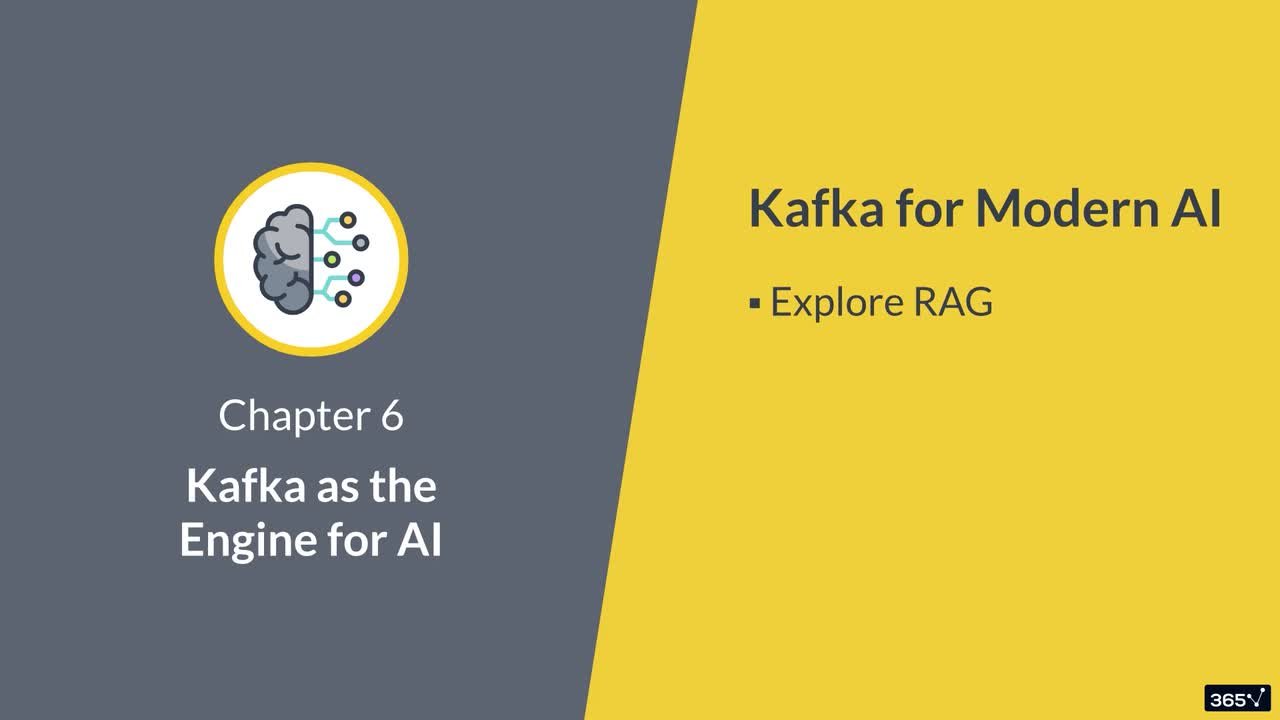
1.2 Course Overview
5 min
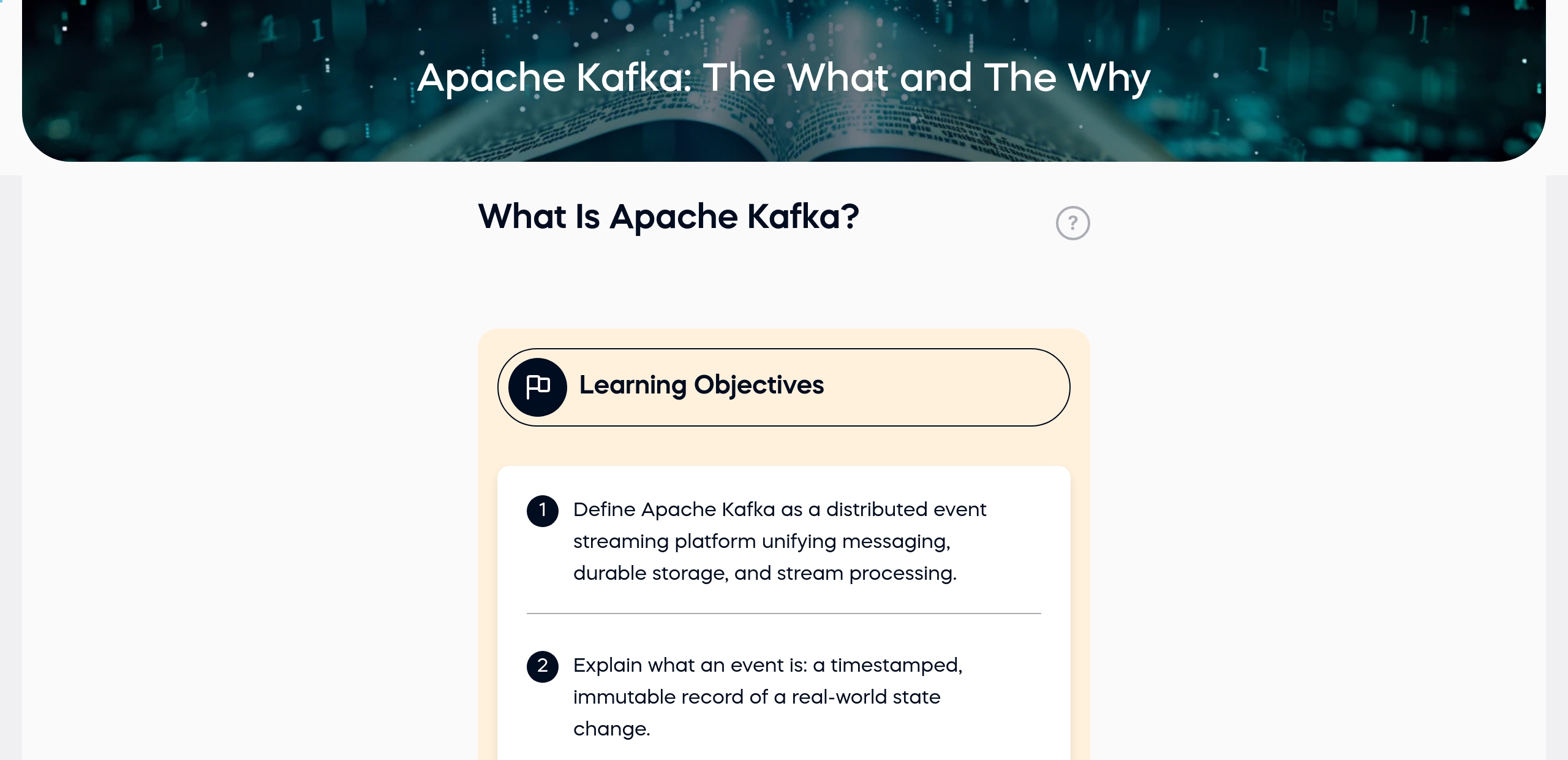
2.1 What Is Apache Kafka?
11 min
2.2 Kafka in Action: Real-World Use Cases
9 min
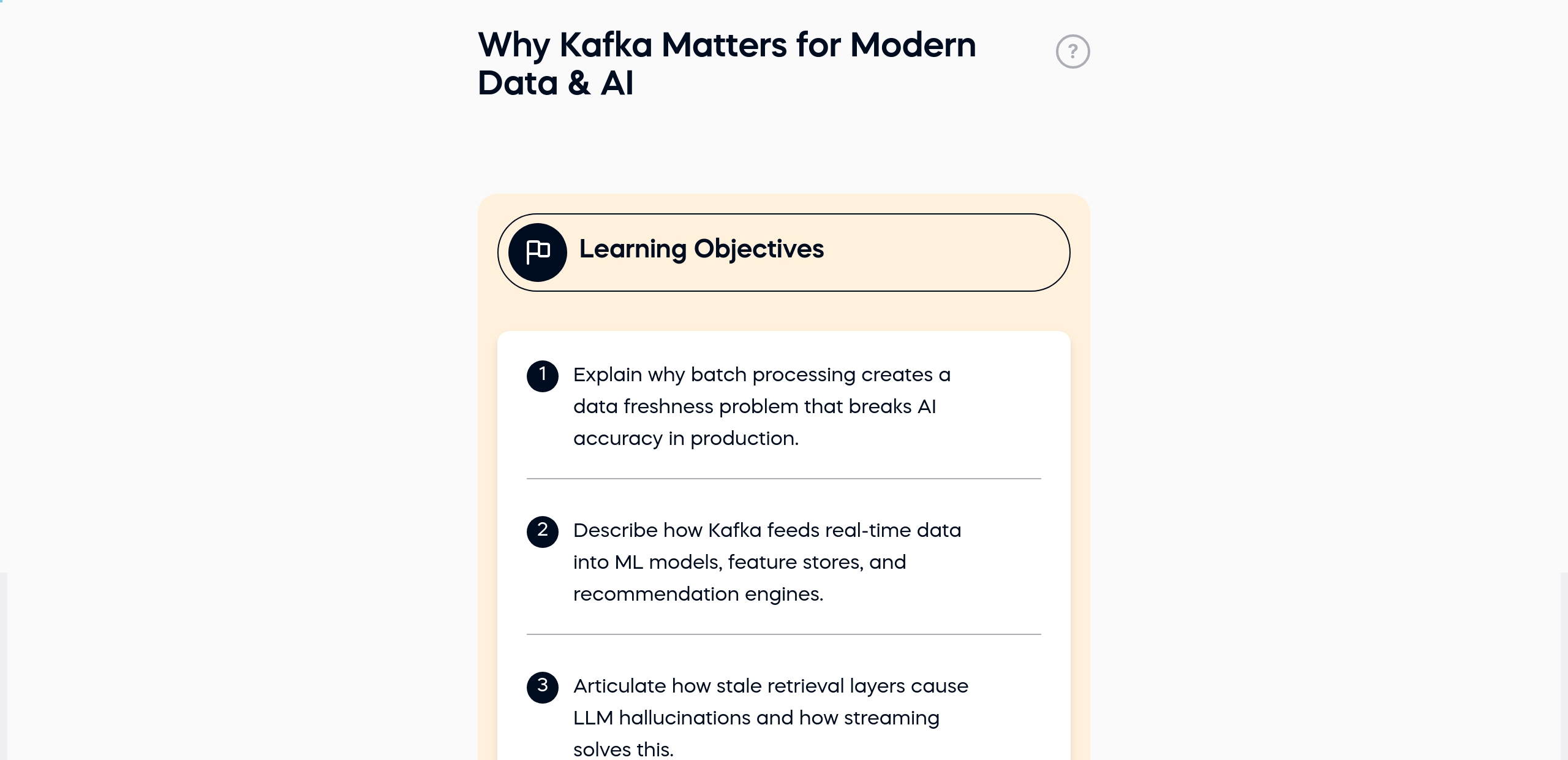
2.4 Why Kafka Matters for Modern Data & AI
12 min
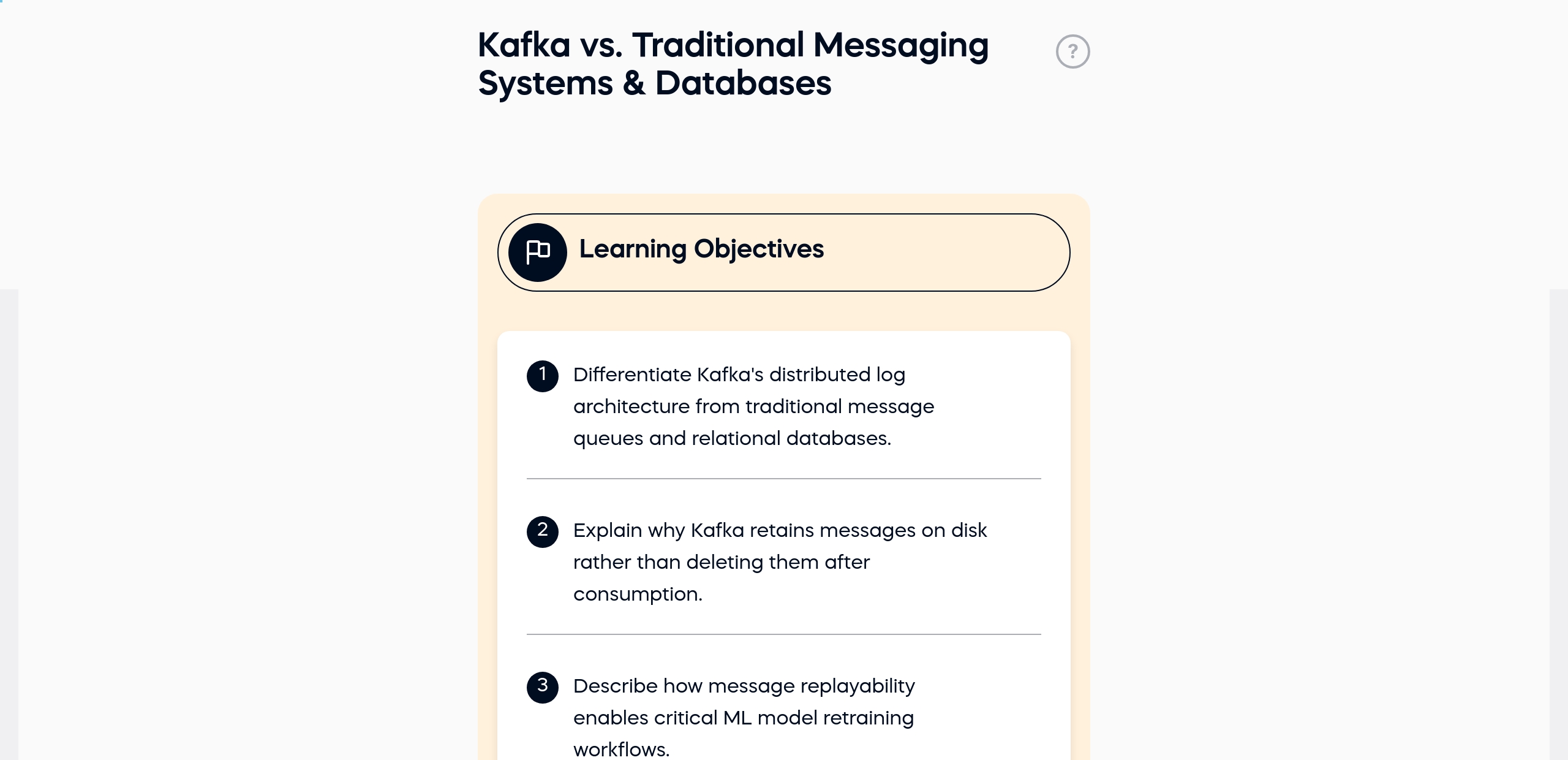
2.5 Kafka vs. Traditional Messaging Systems & Databases
11 min
9 in 10
of our graduates landed a new AI & data job
94%
of AI and data science graduates
successfully change
#1 most reviewed
ACCREDITED certificates
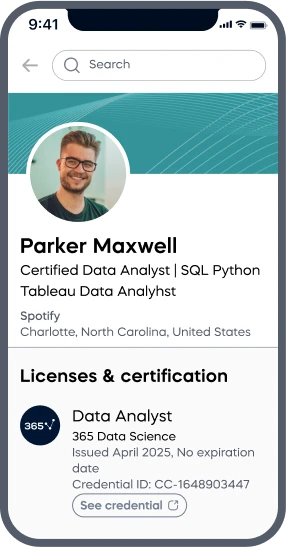
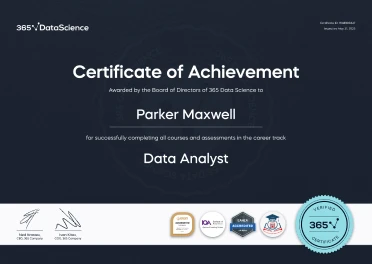
Craft a resume and LinkedIn profile you’re proud of—featuring certificates recognized by leading global
institutions.
Earn CPE-accredited credentials that showcase your dedication, growth, and essential skills—the qualities
employers value most.
Certificates are included with the Self-study learning plan.
How it WORKS
Student REVIEWS