Online Course bestseller
Introduction to Python

Learn to code in Python: the most popular and widely used programming language

4.8

862 reviews on
61,873 students already enrolled
  • Institute of Analytics
  • The Association of Data Scientists
  • E-Learning Quality Network
  • European Agency for Higher Education and Accreditation
  • Global Association of Online Trainers and Examiners

Skill level:

Basic

Duration:

2 hours
  • Lessons (2 hours)
  • Practice exams (25 minutes)
  • Projects (1 hour)

CPE credits:

5
CPE stands for Continuing Professional Education and represents the mandatory credits a wide range of professionals must earn to maintain their licenses and stay current with regulations and best practices. One CPE credit typically equals 50 minutes of learning. For more details, visit NASBA's official website: www.nasbaregistry.org

Accredited

certificate

What you learn

  • Gain a proper introduction to the world of Python programming.
  • Master variables, data types, and conditional statements.
  • Solve practical Python exercises alongside the instructor.
  • Build your first Python program to tackle real‑world tasks.
  • Familiarize yourself with advanced Python programming techniques.

Topics & tools

TheoryJupyterProgrammingPython

Your instructor

Course OVERVIEW

Description

CPE Credits: 5 Field of Study: Information Technology
Delivery Method: QAS Self Study
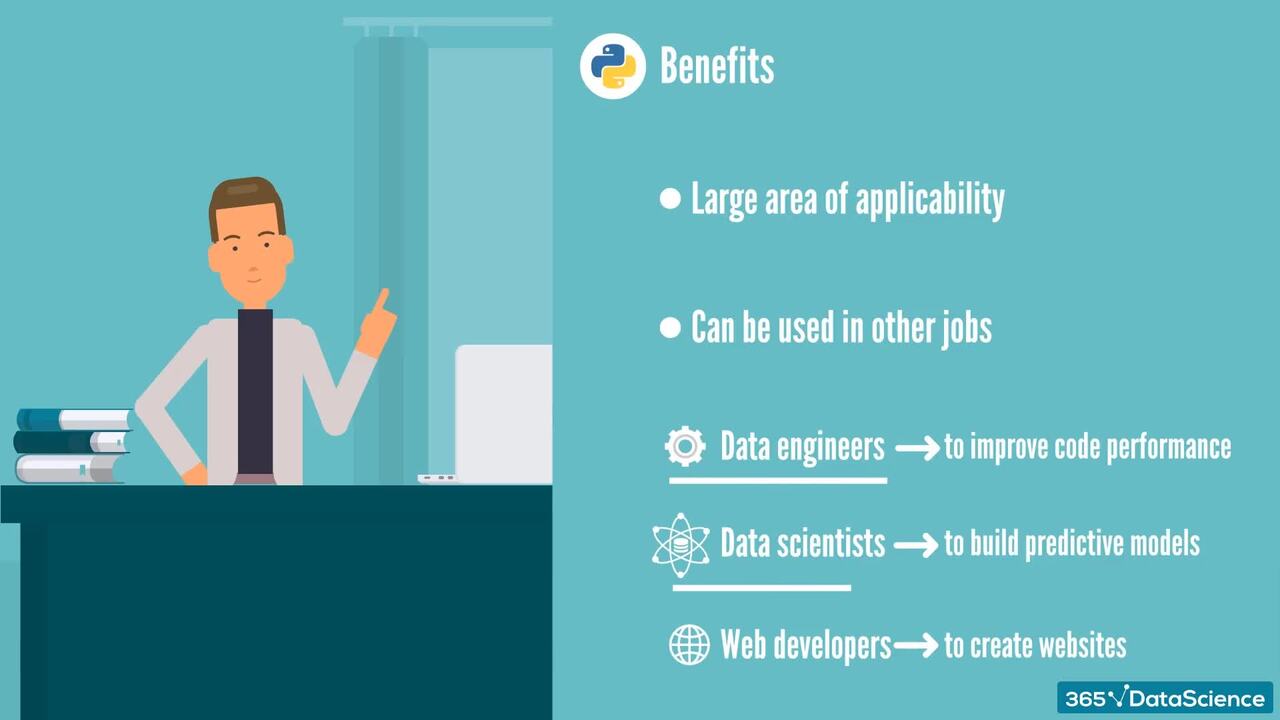
Python is one of the most widely used programming languages among data scientists. This course will show you the technical advantages it has over other programming languages. You will start working with its modules for scientific computing, and you will begin to understand why these functionalities make Python the preferred choice in finance, econometrics, economics, data science, and machine learning.

Prerequisites

  • Jupyter Notebook or JupyterLab (available through anaconda.com or online platforms like Google Colab)

Advanced preparation

  • None

Curriculum

45 lessons 55 exercises 1 project 4 exams
  • 1. Why Python?
    6 min
    In this lecture, we will explain why we focus on studying Python and describe its key features (it is an open-source, general-purpose, high-level language). 
    6 min
    In this lecture, we will explain why we focus on studying Python and describe its key features (it is an open-source, general-purpose, high-level language). 
    Course Introduction Free
    Setting Up the Environment Free
  • 2. Python Variables and Data Types
    20 min
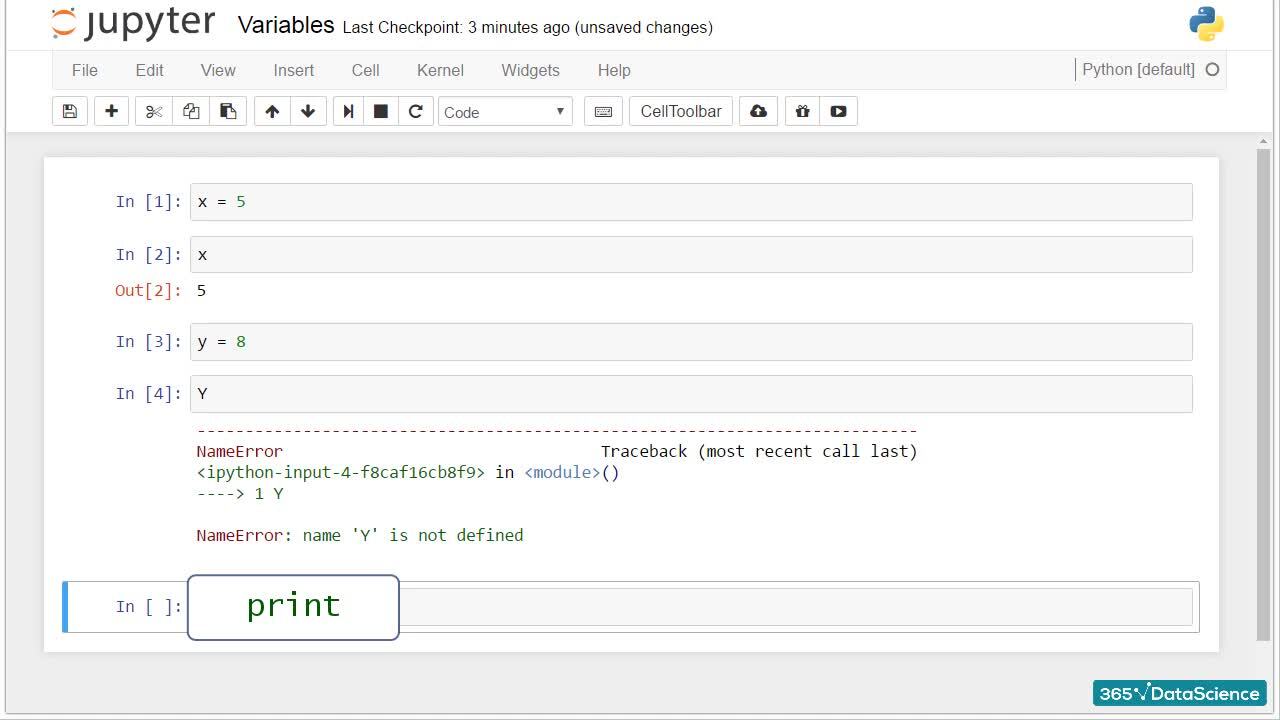
    This is where you will start coding and learn one of the most fundamental concepts in programming – working with variables.
    20 min
    This is where you will start coding and learn one of the most fundamental concepts in programming – working with variables.
    Python Variables Free
    Coding exercise Free
    Exercise Free
    Understanding Numbers and Boolean Values Free
    Coding exercise Free
    Coding exercise Free
    Exercise Free
    Strings Free
    Exercise Free
    Coding exercise Free
    Coding exercise Free
    Introduction to Anaconda AI Free
    Using the Anaconda Assistant: Strings Free
  • 3. Basic Python Syntax
    12 min
    If you want to master Python programming, there is no way around learning basic Python syntax operators first. In this section, we will cover the double equality sign, reassigning of values, adding comments, line continuation, indexing elements, arithmetic operators, comparison operators, logical operators, and identity operators.
    12 min
    If you want to master Python programming, there is no way around learning basic Python syntax operators first. In this section, we will cover the double equality sign, reassigning of values, adding comments, line continuation, indexing elements, arithmetic operators, comparison operators, logical operators, and identity operators.
    The Arithmetic Operators of Python Free
    Exercise Free
    Coding exercise Free
    What is the Double Equality Sign? Free
    Coding exercise Free
    Exercise Free
    How to Reassign Values Free
    Coding exercise Free
    Exercise Free
    How to Add Comments Free
    Exercise Free
    Understanding Line Continuation Free
    How to Index Elements Free
    Coding exercise Free
    Exercise Free
    How to Structure Your Code with Indentation Free
    Exercise Free
    Coding exercise Free
  • 4. More on Operators
    8 min
    In this section, we will explore more operators used in Python. More precisely, we will first learn about the comparison operators, which will obviously allow you to compare different values in your code. Then, we will focus on the logical operators AND, OR, and NOT. We will conclude by a few examples with the identity operators IS and IS NOT.
    8 min
    In this section, we will explore more operators used in Python. More precisely, we will first learn about the comparison operators, which will obviously allow you to compare different values in your code. Then, we will focus on the logical operators AND, OR, and NOT. We will conclude by a few examples with the identity operators IS and IS NOT.
    Python's Comparison Operators
    Exercise
    Coding exercise
    Python's Logical and Identity Operators
    Exercise
    Coding exercise
  • 5. Conditional Statements
    14 min
    Conditional statements are the bread and butter of programming. Here, you will start creating your own IF, ELSE, and ELIF statements.
    14 min
    Conditional statements are the bread and butter of programming. Here, you will start creating your own IF, ELSE, and ELIF statements.
    Getting to know the IF Statement
    Exercise
    Coding exercise
    Adding an ELSE Statement
    Coding exercise
    Else if, for Brief – ELIF
    Coding exercise
    An Additional Explanation of Boolean Values
    Exercise
  • 6. Functions
    19 min
    Python functions are another invaluable tool for programmers. They allow you to carry out pre-defined or specifically-designed operations that manipulate the data you are working with and bring it one step closer to representing a meaningful output.
    19 min
    Python functions are another invaluable tool for programmers. They allow you to carry out pre-defined or specifically-designed operations that manipulate the data you are working with and bring it one step closer to representing a meaningful output.
    How to Define a Function in Python
    Exercise
    How to Create a Function with a Parameter
    Coding exercise
    Another Way to Define a Function
    Exercise
    Coding exercise
    How to use a Function within a Function
    Coding exercise
    Use Conditional Statements and Functions Together
    Coding exercise
    How to Create Functions Which Contain a Few Arguments
    Built-In Functions in Python Worth Knowing
    Coding exercise
  • 7. Sequences
    19 min
    Sequences are one of the main building blocks of computer programming. A sequence helps you store and organize different values you are working with. We will teach you how to work with lists, list slicing, tuples, and dictionaries.
    19 min
    Sequences are one of the main building blocks of computer programming. A sequence helps you store and organize different values you are working with. We will teach you how to work with lists, list slicing, tuples, and dictionaries.
    Introduction to Lists
    Exercise
    Coding exercise
    Using Methods in Python
    Exercise
    Coding exercise
    What is List Slicing?
    Coding exercise
    Working with Tuples
    Coding exercise
    Python Dictionaries
    Practice exam
    Exercise
    Coding exercise
  • 8. Iteration
    25 min
    Iterations are a programming technique which allows you to execute certain code repeatedly. This is one of the instruments letting you to automate repeated tasks and benefit from one of its main strong points.
    25 min
    Iterations are a programming technique which allows you to execute certain code repeatedly. This is one of the instruments letting you to automate repeated tasks and benefit from one of its main strong points.
    Using For Loops
    Exercise
    Using While Loops and Incrementing
    Use the range() Function to Create Lists
    Exercise
    Coding exercise
    Combine Conditional Statements and Loops
    Coding exercise
    All In – Conditional Statements, Functions, and Loops
    Coding exercise
    Using the Anaconda Assistant: Several Python Tools
    How to Iterate over Dictionaries
    Using the Anaconda Assistant: Dictionaries
  • 9. A few important Python concepts and terms
    22 min
    There are a few crucial concepts that everyone working with Python must understand – classes, object, object-oriented programming (OOP), Python standard library, functions, methods, attributes, etc. Although we will pay particular attention to all these terms later in the program, we believe it is very important to have been briefly introduced to them now.
    22 min
    There are a few crucial concepts that everyone working with Python must understand – classes, object, object-oriented programming (OOP), Python standard library, functions, methods, attributes, etc. Although we will pay particular attention to all these terms later in the program, we believe it is very important to have been briefly introduced to them now.
    Object-Oriented Programming (OOP)
    Exercise
    Modules, Packages and the Python Standard Library
    Exercise
    Importing Modules in Python
    Practice exam
    Exercise
    What is Software Documentation?
    Practice exam
    The Python Documentation
  • 10. Course project and exam
    85 min
    85 min
    Prime Numbers in Python Project Free
    Course exam

Free lessons

Course Introduction

1.1 Course Introduction

5 min

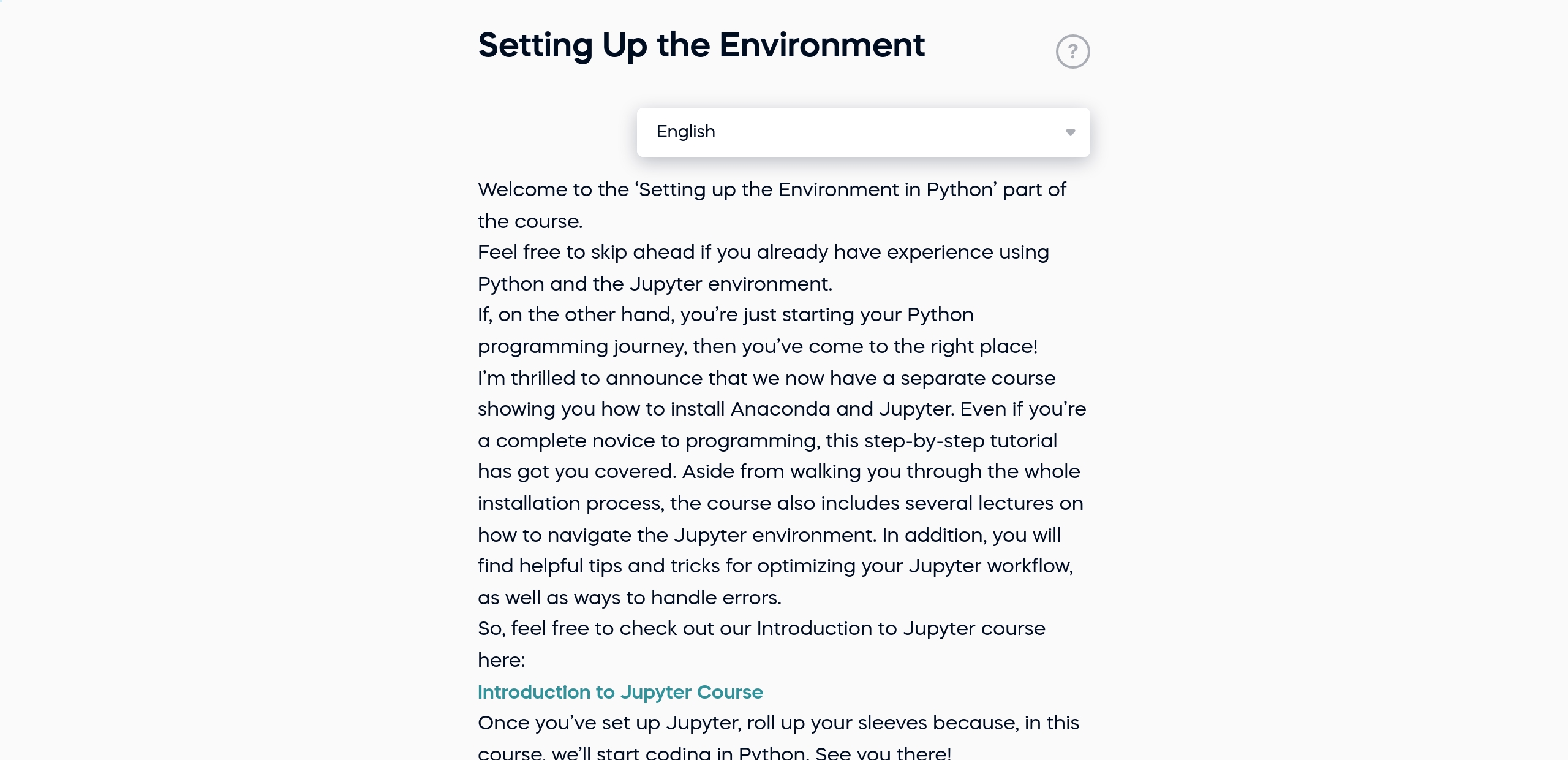
Setting Up the Environment

1.2 Setting Up the Environment

1 min

Python Variables

2.1 Python Variables

5 min

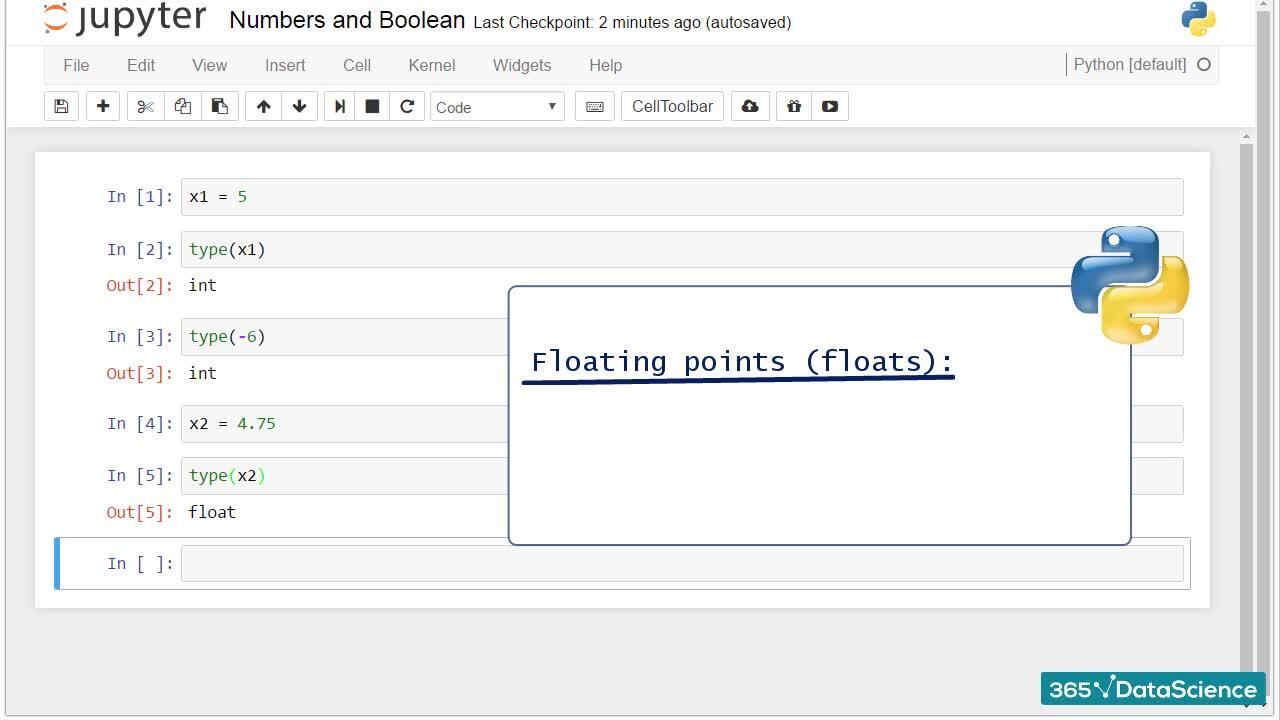
Understanding Numbers and Boolean Values

2.4 Understanding Numbers and Boolean Values

3 min
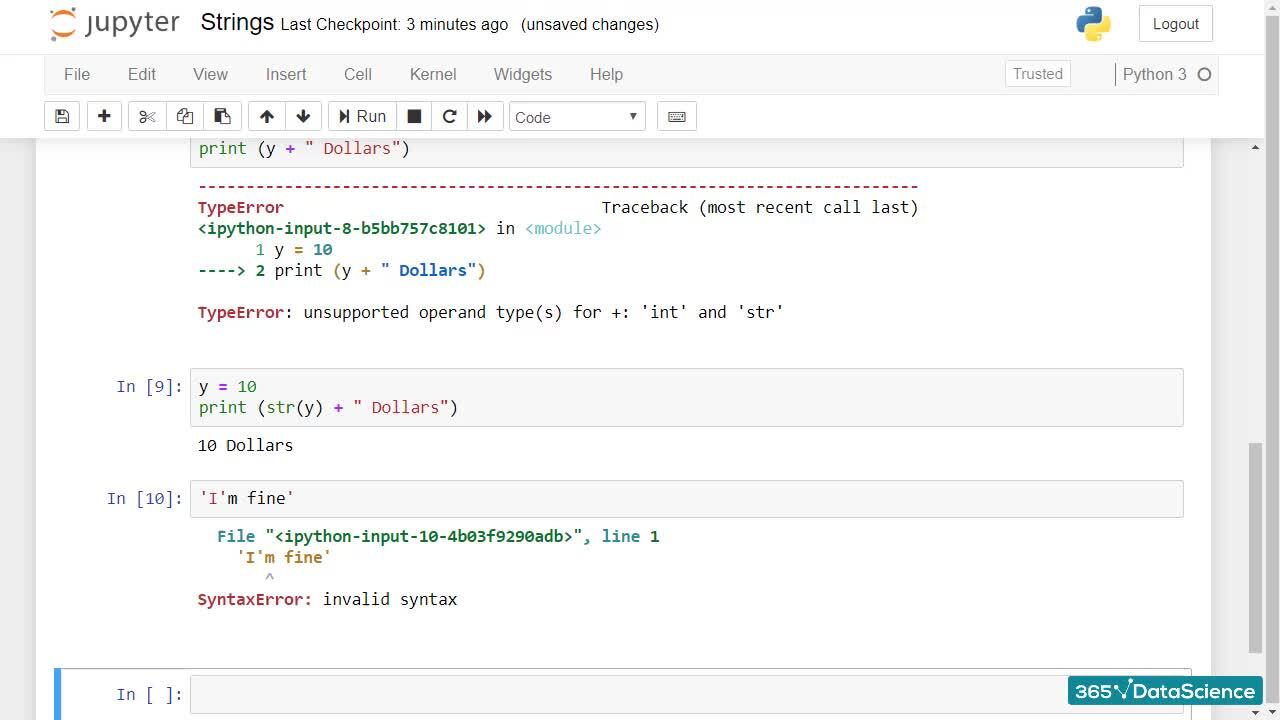
Strings

2.8 Strings

6 min

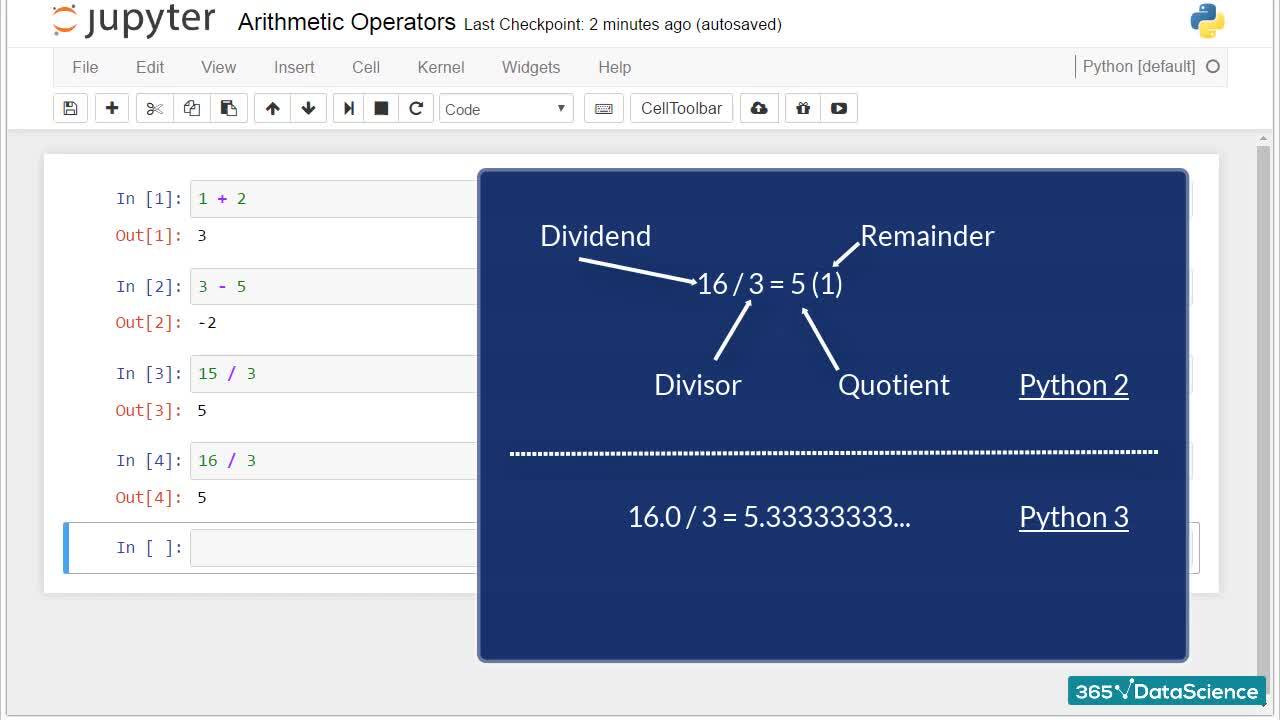
The Arithmetic Operators of Python

3.1 The Arithmetic Operators of Python

3 min

Start for free

96%

of our students recommend

365 Data Science.

$29,000

average salary increase

after moving to an AI and data science career

9 in 10

of our graduates landed a new AI & data job

after enrollment

ACCREDITED certificates

Craft a resume and LinkedIn profile you’re proud of—featuring certificates recognized by leading global institutions.

Earn CPE-accredited credentials that showcase your dedication, growth, and essential skills—the qualities employers value most.

  • Institute of Analytics
  • The Association of Data Scientists
  • E-Learning Quality Network
  • European Agency for Higher Education and Accreditation
  • Global Association of Online Trainers and Examiners

Certificates are included with the Self-study learning plan.
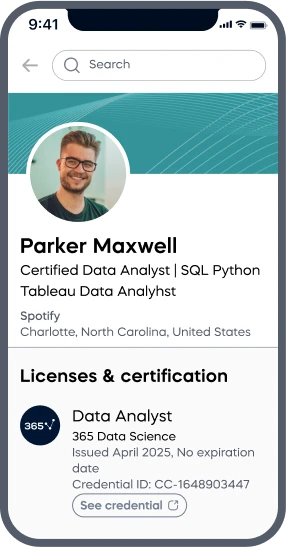
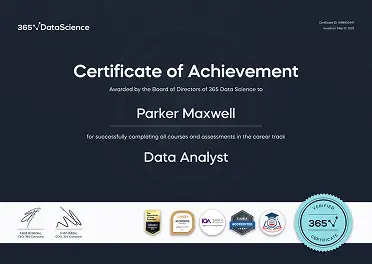
A LinkedIn profile mockup on a mobile screen showing Parker Maxwell, a Certified Data Analyst, with credentials from 365 Data Science listed under Licenses & Certification. A 365 Data Science Certificate of Achievement awarded to Parker Maxwell for completing the Data Analyst career track, featuring accreditation badges and a gold “Verified Certificate” seal.

How it WORKS

  • Lessons
  • Exercises
  • Projects
  • Practice exams
  • AI mock interviews

Lessons

Learn through short, simple lessons—no prior experience in AI or data science needed.

Try for free

Exercises

Reinforce your learning with mini recaps, hands-on coding, flashcards, fill-in-the-blank activities, and other engaging exercises.

Try for free

Projects

Tackle real-world AI and data science projects—just like those faced by industry professionals every day.

Try for free

Practice exams

Track your progress and solidify your knowledge with regular practice exams.

Try for free

AI mock interviews

Prep for interviews with real-world tasks, popular questions, and real-time feedback.

Try for free

Student REVIEWS

A collage of student testimonials from 365 Data Science learners, featuring profile photos, names, job titles, and quotes or video play icons, showcasing diverse backgrounds and successful career transitions into AI and data science roles.