
Starting a business is risky, and many companies struggle to survive and grow over the long term. Failure rates vary considerably by industry, location, economic conditions, and the type of business, so no single percentage captures every startup’s prospects.
The pressure often intensifies once a company has launched its product and must turn an initial idea into a sustainable operation. At this stage, resources remain limited, there is little room for error, and leadership must adopt a strategy that turns challenges into advantages.
But that’s easier said than done.
With pressing operating issues, limited time and finances, and insufficient employees, data science may be the last thing on a small business owner’s mind. But data is essential to make an informed decision. Business acumen is also necessary, of course, but without data, any strategic decision is a shot in the dark.
Data is one of the most powerful tools for achieving sustainable growth in today’s business environment. The earlier a company begins using it effectively, the more opportunities it has to learn, adapt, and improve.
Still not convinced? Keep reading to learn more about the benefits and applications of data for a small business, and watch the video below for a real-life example. But first, let’s see how many companies use data and how they benefit from it.
Data Science for Small Business Growth: Table of Contents
- How Many Businesses Use Data?
- Can a Small Business Benefit from Data Science?
- Applications of Data Science and Analytics for Small Businesses
- How Small Business Owners Use Data Science and Analytics: Real-World Example
- Next Steps
How Many Businesses Use Data?
Data and analytics tools are more accessible than ever, but adoption and maturity remain uneven. Many companies collect information through their websites, sales platforms, accounting systems, customer relationships, and day-to-day operations without consistently turning it into useful insights.
The growing adoption of artificial intelligence illustrates both the opportunity and the gap. In 2026, US Census Bureau data showed that overall business AI use hovered between 17% and 20%, while fewer than 20% of businesses with four or fewer employees reported using it. OECD research likewise indicates that small and medium-sized enterprises adopt AI less frequently than larger organizations.
This suggests that access to technology is only part of the equation. Businesses also need reliable data, clearly defined goals, appropriate skills, and processes that turn analysis into action. Companies that develop these capabilities can improve:
- Efficiency and productivity
- Decision-making
- Financial performance
- Customer acquisition and retention
- Customer experience
- Product and service development
- Competitive positioning
All research points to this. Big data and analytics are increasingly important in today’s business world. If implemented correctly, they give companies a competitive advantage.
But does that hold true for companies of all sizes? And if so, how can a small business use data science and analytics to grow?
Can a Small Business Benefit from Data Science?
Very often, entrepreneurs find themselves caught in the ‘’live to fight another day’’ trap. With multiple pressing operating issues, few skilled employees, and a bottom line in red, startup founders and small business owners feel that investment in data strategy, data collection, and data analysis is a luxury they cannot afford. So, they often prefer to dedicate their energy to actions that will produce results now rather than in a year.
This mindset is reminiscent of Gil Amelio, (Apple’s CEO before Steve Jobs took over). In a question on how the tech company was doing, Amelio famously said: “Apple is like a ship with a hole in the bottom, leaking water, and my job is to get the ship pointed in the right direction.”
If you’re the captain of a sinking ship, would you try to point it in the right direction, or would you try to do something about the hole in its structure instead?
Running a business without utilizing data is like sailing with a leaky ship. You may keep moving in the right direction for a while, but you won’t get far
In contrast, with a data strategy, you can stay the course and adjust the direction when necessary. You can identify and fix problems quickly, foresee trends and issues, and change your strategy accordingly.
Small businesses have scarce resources—which is precisely why they cannot afford to waste them. Data-driven decision-making can help them allocate those resources more effectively and reduce unnecessary guesswork.
But enough with the sailing analogies. It’s time to provide practical examples of how data science can help a small business grow.
Applications of Data Science and Analytics for Small Businesses
At this point, you might be wondering, “Can all small businesses benefit from data? Isn’t this framework mostly beneficial for digital start-ups rather than traditional firms?”
That’s a common misconception. Regardless of size and domain, if your company needs to understand its customers, improve its product, or optimize its operations, you need a data strategy.
Here’s what a small business can achieve using data science.
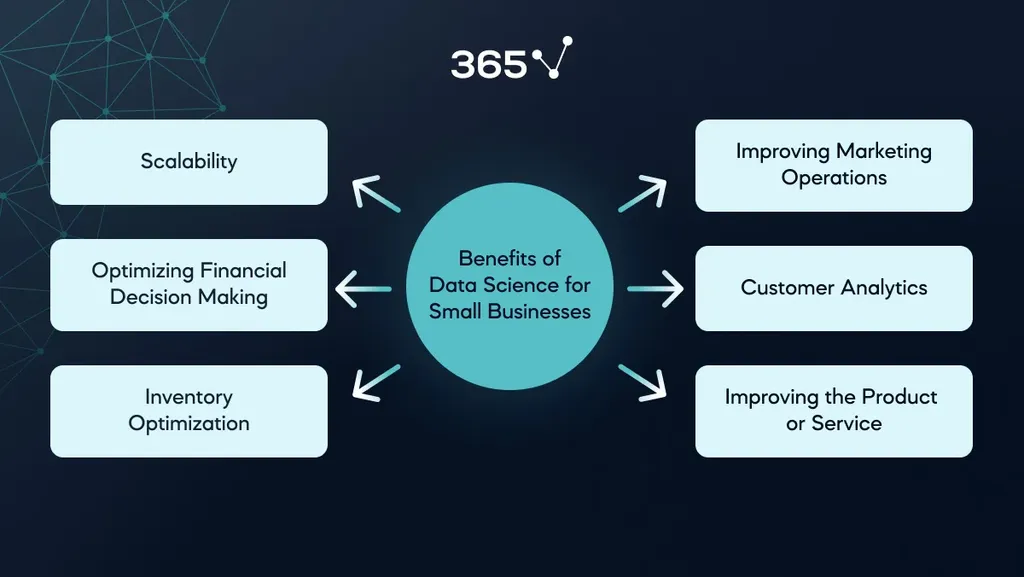
A useful data strategy must also address data quality, privacy, access controls, and security. Small businesses should collect only the information they genuinely need, document how it is used, restrict access to sensitive records, and comply with the privacy requirements that apply to their customers and location.
AI-Assisted Analytics for Small Businesses
Artificial intelligence has made some forms of data analysis more accessible to small businesses. AI-enabled spreadsheet, accounting, customer relationship management, and business intelligence tools can help users summarize information, identify patterns, create visualizations, draft reports, and explore data using natural-language questions. This allows small teams to perform useful analysis without immediately building custom machine learning systems or hiring a full data science department.
These tools do not eliminate the need for data literacy or human judgment. AI-generated analyses can contain errors, overlook important context, or produce convincing conclusions from incomplete or poor-quality data. Small businesses should begin with a clearly defined problem, verify the underlying information, review important outputs, and measure whether the tool improves a meaningful business result. AI is most valuable when it supports a sound data strategy rather than replacing one.
Scalability
Data-driven business growth is making evidence-based decisions to improve performance, sales, operations, etc. That is the only way to achieve sustainable development in today’s business world.
Deriving actionable insights from data allows business owners to make informed decisions about the company’s development direction. Every organization produces tons of information daily. Customer behavior, communication records, marketing, and transaction information—these are data gold mines waiting to be leveraged.
With the help of data analytics, any small business can detect patterns and gain valuable insights. They can leverage the obtained information to adjust the firm’s strategy and compete successfully in a dynamic market environment.
Optimizing Financial Decision Making
From determining the product or service costs to estimating the marketing budget, data is the key to optimizing the financial decision-making of companies of all sizes.
With the help of data analytics, any small business can do the following:
- Analyze current and historical data to understand and predict the company’s financial health
- Reduce expenses to improve efficiency (i.e., cost optimization)
- Analyze data in real-time to adjust marketing campaign budgets
- Compare different strategies and solutions and invest in the most effective one
- Forecast cash flow needs and allocate financial resources effectively
The list goes on. By systematically gathering and analyzing data, small companies can optimize their financial decision-making in various ways.
Inventory Optimization
Small companies cannot afford to waste resources, and inefficient inventory management is one of the biggest threats to their budget. Data can help determine and apply the most suitable inventory management strategy for the business and its niche. Using data science and analytics, companies estimate the required quantity and timing of stocking and identify seasonality in product demand.
It’s better to invest in the accurate prediction of supply and demand than to stock out or overstock and risk losing customers or waste valuable resources. Advanced inventory forecasting systems can require significant data, technical expertise, and investment. But small businesses can begin with historical sales data, spreadsheet-based forecasts, and forecasting features built into existing inventory or business intelligence platforms before considering a custom machine learning solution.
Fortunately, there are cheaper data analytics and business intelligence solutions small business owners can apply. During the initial stages of development, they can achieve good results with efficient data planning and analysis using, for example, Excel or BI analysis tools.
Customer Analytics
Every business’s goal is to attract and retain customers. But without data, any effort to do so is a shot in the dark. Customer data analytics can help small businesses identify the most profitable users and invest extra efforts in retaining them.
With the help of customer churn prediction, companies can detect users losing interest early on and prevent them from leaving. They can improve engagement and increase the customer lifetime value by extracting and categorizing behavioral patterns.
In addition, they can analyze data from social media and other communications channels to understand customer preferences better. This would allow them to identify pain points and improve their products or services to increase satisfaction.
Improving customer attraction and retention positively impacts every aspect of the business. As such, customer analytics should be a top priority when creating a small business’s data analytics strategy.
Improving Marketing Operations
Data science and analytics can help small business marketing teams make effective resource allocation decisions. How? Here are a few examples.
Competitor analysis helps companies understand the market, foresee trends, identify successful strategies, etc. This eliminates the guesswork, allowing managers to focus marketing efforts and maximize results.
In addition, performance tracking and analysis are crucial for determining a campaign’s success. The marketing team can use previous experience to improve future performance, thereby ensuring continuous development.
Further, marketing specialists can use A/B testing to compare different campaign elements and select the most successful one. With the help of real-time analytics, they can adjust a campaign’s budget to maximize gains.
Further down the line, a small business can hire a data science expert to perform more complex tasks, such as predictive analytics. They could, for example, determine which prospects are most likely to convert into customers. The marketing team can use this knowledge to design campaigns targeting these users.
The list goes on. With data science, the opportunities for development and improvement are limitless.
Improving the Product or Service
Delivering a product or service customers need is the key to success. After launching their product, small businesses’ main task is to gather and analyze user data. Why? That’s the only way to assess what works (and what doesn’t) and improve the product.
Moreover, they can provide a customized experience via, for example, recommender systems. A fully customized recommender system may require specialist expertise, but smaller companies can begin with recommendation features offered by their e-commerce platforms or use simpler rules based on purchase history, product categories, and customer behavior.
Therefore, owners must carefully assess their priorities and their team’s capabilities to determine where to invest their resources first. Once they start growing, they can expand their data strategy and introduce new operations.
Of course, it won’t be all smooth sailing—running a business is no easy feat. But having a data-driven strategy will help small enterprises to find the hole in the bottom of the ship, patch it up, and steer the wheel in the right direction. With this approach, they’ll reach their desired destination sooner or later.
Still not convinced any business can benefit from a data strategy? Let’s see two real-world examples of how data can help traditional and digital companies grow.
How Small Business Owners Use Data Science and Analytics: Real-World Example
Let’s compare the data strategies of a chain of brick-and-mortar bookstores and an exclusively online book retailer, which started operating a year ago.
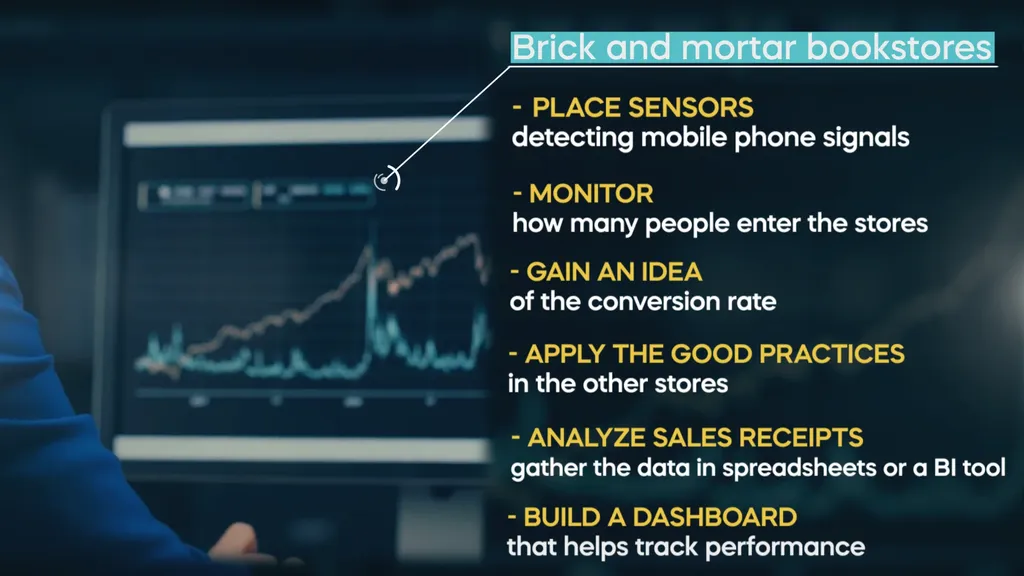
Presumably, brick-and-mortar stores have less data than digital businesses, which puts them at a slight disadvantage. Nevertheless, management has multiple options to utilize data and begin collecting insights. Here are a few of them.
For starters, they can place sensors that detect mobile phone signals on shop windows to collect footfall data. That way, they’ll ensure the stores are in areas with sufficient customer traffic.
Further, monitoring how many people enter the stores can help assess the effectiveness of different promotional messages and shop windows arrangements. The ones that attract the most significant number of customers are the most effective. By using them, the stores will attract more customers and increase engagement. That’s essentially the real-life version of A/B testing.
By combining footfall data with the number of visitors who purchase one or more books, management can calculate the conversion rate for each store.
They can also explore whether this benchmark is consistent across all their locations. The insights will help them understand if and why one site outperforms the rest. Then, they can apply the successful strategies in the other stores.
How else can data science help a brick-and-mortar business?
The data team can use the information from sales receipts to find the relationship between store discounts and volumes sold. This reveals valuable information about price sensitivity.
And lastly, they can build a dashboard to track performance at the store level. This would reveal, for example, the sales rate of different genres and the success of promotions throughout the year. But the ultimate goal of data dashboards is to provide specific targets and give the team a sense of common purpose.
So, that’s how brick-and-mortar businesses can benefit from data-driven decision-making. Let’s consider how data science can help a small digital bookstore business.
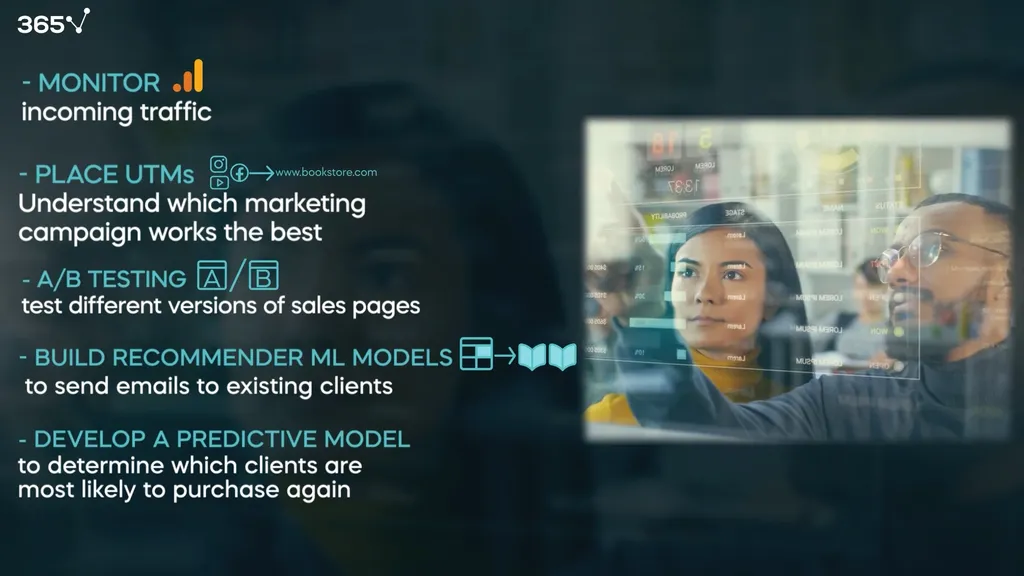
Starting from the basics, any online business needs to analyze website data. Using Google Analytics 4, or another privacy-appropriate web analytics platform, allows the digital bookstore to monitor traffic sources, user journeys, key events, and conversion rates.
Next, place UTMs on all external links to the website. That way, the marketing team can evaluate the performance of different campaigns and social media ads. Experimenting with varying versions of sales pages through A/B testing will help them implement the most successful versions of advertising materials.
In addition, the digital bookstore will benefit from a recommender system. Building such ML models requires advanced expertise, which may be costly and time-consuming. It will, however, help the business generate relevant book recommendations, thus increasing the chance of repeated purchases.
Another advanced and beneficial technique is developing a predictive model. Such a system can determine which clients are most likely to purchase again using demographic data and recorded interactions from the website. With appropriate customer consent and privacy controls, the company can use these insights to create relevant retention campaigns across email and advertising platforms such as Meta, LinkedIn, and Google.
These are just a few examples of how small businesses, both physical and digital, can benefit from a data-driven approach. Of course, there are many more ways to take advantage of data in both cases.
Here’s one final piece of advice.
Before you reach an advanced stage of data maturity in your organization, it’s much better to focus on traditional forms of data analysis. Becoming a truly data-driven business is a long and winding road, but the journey is rewarding. Hopefully, we inspired you to take on this challenge.
In 2026, becoming data-driven does not necessarily mean building a large data science team or adopting every new AI tool. It means collecting useful information responsibly, asking focused business questions, testing decisions against evidence, and gradually investing in more advanced capabilities as the company grows.
Next Steps
One of the best ways to prepare your team for implementing a data strategy is provide comprehensive data literacy training. The 365 Data Science program offers courses in Data Literacy, Data Strategy, Python, SQL, and Excel fundamentals. It also covers more advanced topics, such as Business Analytics, Tableau, Power BI, Machine Learning, and many others.
If you’re ready for this step, take our Data-Driven Growth course, which will teach you how to transform a small business using data science.
Sign up for free and try the 365 Data Science program. We’d be glad to be part of your company’s data-fueled journey to success!