Quant finance analyst
New

How to become a

Quant finance analyst

CAREER TRACK

Build the mathematical, statistical, and programming skills required to analyze financial markets, model risk, and develop data-driven investment strategies.

Enroll now

4.9

869 reviews on
10 AI & data science courses
100% online
Content: 48 hours
Skill level: advanced
CPE credits available
CPE stands for Continuing Professional Education and represents the mandatory credits a wide range of professionals must earn to maintain their licenses and stay current with regulations and best practices. One CPE credit typically equals 50 minutes of learning. For more details, visit NASBA's official website: www.nasbaregistry.org
Accredited certificate

The Quantitative Finance Analyst Track is designed for learners who want to apply data science, econometrics, and machine learning techniques to real financial problems. Throughout the program, you will learn how to:

  • Work with financial datasets
  • Build predictive models,
  • Analyze time series data,
  • Apply advanced machine learning methods

These techniques are applied to areas such as asset pricing, portfolio optimization, and credit risk.

Along the way, you will gain practical experience using quantitative techniques to solve problems commonly faced in the financial industry. By the end of this track, you will be able to transform complex financial data into actionable insights and develop quantitative models used in investment firms, banks, fintech companies, and hedge funds.

Begin now
Quant finance analyst job
Entry-level salary (USD, per year) $119,550
Projected job growth (next 10 years) 28.3%
Key responsibilities
Build quantitative pricing, forecasting, and financial prediction models using time-series data
Core skills
Python, NumPy, Econometrics, Time Series Analysis, Machine Learning, Financial Modeling, Quantitative Problem-solving
Top companies for Quant Finance Analyst
National Registry of CPE SponsorsInstitute of AnalyticsThe Association of Data ScientistsE-Learning Quality NetworkEuropean Agency for Higher Education and AccreditationGlobal Association of Online Trainers and Examiners
We’re an accredited institution

Earn your Quant Finance Analyst certification through an accredited program proven to deliver results. 100% online.

9 in 10
of our graduates landed a new AI and data science job after enrollment
94%
of AI and data science graduates successfully change or advance their careers
$29,000
average salary increase after moving to an AI and data science career
Student outcomes report
Curriculum Projects Certificates Student outcomes Careers More career paths
Overview

Quantitative finance analysts—often called quants—use mathematics, statistics, and programming to analyze financial markets and build predictive models.

They work with large financial datasets to forecast asset prices, model risk, design trading strategies, and evaluate creditworthiness. By combining econometrics, time series analysis, and machine learning, quants help financial institutions make data-driven investment and risk decisions.

In this career track, you’ll learn how to apply Python, statistical modeling, and advanced machine learning techniques to real financial problems—from market forecasting and volatility modeling to credit risk analysis.

By the end of the program, you will have the technical skills required to pursue roles in investment banking, asset management, hedge funds, and fintech.

As you progress through the Quant Finance Analyst career path, you’ll follow a curated roadmap covering:

  • Financial math
  • Python programming
  • Time series analysis
  • Econometrics fundamentals
  • Machine learning
Curriculum CPE credits
ONLINE COURSE

Math for Finance

Strengthen your mathematical foundation for quantitative finance. This course covers key topics such as probability theory, linear algebra, and calculus, which are essential for understanding financial models and advanced quantitative methods.

See details
ONLINE COURSE

Introduction to Python

Start your journey by learning Python, the most widely used programming language in quantitative finance and data science. You will learn programming fundamentals, data structures, and how to work with Python libraries used in financial analysis.

See details
ONLINE COURSE

Data Preprocessing with NumPy

Master numerical computing with NumPy and learn how to efficiently manipulate large financial datasets. You will practice data cleaning, transformation, and preparation techniques that are essential for building reliable quantitative models.

See details
ONLINE COURSE

Econometrics I

Learn how to apply statistical methods to economic and financial data. This course introduces regression analysis, hypothesis testing, and model evaluation techniques widely used in finance and research.

See details
ONLINE COURSE

Time Series Analysis with Python

Understand how financial data evolves over time. In this course, you will learn how to model trends, seasonality, and autocorrelation in financial time series and build forecasting models using Python.

See details
ONLINE COURSE

Advanced Time Series Analysis with Python

Dive deeper into time series modeling with advanced techniques such as ARIMA, GARCH, and volatility modeling. These methods are essential for analyzing market dynamics and predicting financial behavior.

See details
ONLINE COURSE

Advanced Machine Learning and AI Applications in Finance

Apply modern machine learning and AI techniques to real financial problems. You will build models for portfolio management, asset pricing, and market prediction using Python and real-world datasets.

See details
ONLINE COURSE

Credit Risk Modeling in Python

Learn how financial institutions assess credit risk. This course teaches you how to build predictive models that estimate default probabilities and evaluate borrower risk using statistical and machine learning techniques.

See details
ONLINE COURSE

Python for Finance

Learn how to apply Python to financial data analysis. This course covers working with financial datasets, performing quantitative analysis, and building simple models used in investment and risk analysis.

See details
ONLINE COURSE

Data Cleaning and Preprocessing with pandas

Develop the skills needed to prepare real-world datasets for analysis. You will learn how to clean, transform, and structure financial data using pandas to ensure it is ready for statistical modeling and machine learning.

See details
Your instructors
Martin Ganchev
Content Creator & Content Manager at 365 Data Science | Data Science Instructor

Worked with:

Viktor Mehandzhiyski
Data Analyst | Former Data Scientist at NielsenIQ | Course Author at 365 Data Science

Worked with:

Nikolay Georgiev
Data Science Leader | Business Impact with AI & Behavioral Insights

Worked with:

Ned Krastev
Founder & CEO, 365 Careers | Co-founder, 365 Data Science

Worked with:

Professor Gerhard Kling
Professor | YouTuber | Data Nerd

Worked with:

Egor Howell
Machine Learning Engineer @ Deliveroo/DoorDash

Worked with:

Sign up now
Curriculum CPE credits
ONLINE COURSE

Math for Finance

Strengthen your mathematical foundation for quantitative finance. This course covers key topics such as probability theory, linear algebra, and calculus, which are essential for understanding financial models and advanced quantitative methods.

See details
ONLINE COURSE

Introduction to Python

Start your journey by learning Python, the most widely used programming language in quantitative finance and data science. You will learn programming fundamentals, data structures, and how to work with Python libraries used in financial analysis.

See details
ONLINE COURSE

Data Preprocessing with NumPy

Master numerical computing with NumPy and learn how to efficiently manipulate large financial datasets. You will practice data cleaning, transformation, and preparation techniques that are essential for building reliable quantitative models.

See details
ONLINE COURSE

Econometrics I

Learn how to apply statistical methods to economic and financial data. This course introduces regression analysis, hypothesis testing, and model evaluation techniques widely used in finance and research.

See details
ONLINE COURSE

Time Series Analysis with Python

Understand how financial data evolves over time. In this course, you will learn how to model trends, seasonality, and autocorrelation in financial time series and build forecasting models using Python.

See details
ONLINE COURSE

Advanced Time Series Analysis with Python

Dive deeper into time series modeling with advanced techniques such as ARIMA, GARCH, and volatility modeling. These methods are essential for analyzing market dynamics and predicting financial behavior.

See details
ONLINE COURSE

Advanced Machine Learning and AI Applications in Finance

Apply modern machine learning and AI techniques to real financial problems. You will build models for portfolio management, asset pricing, and market prediction using Python and real-world datasets.

See details
ONLINE COURSE

Credit Risk Modeling in Python

Learn how financial institutions assess credit risk. This course teaches you how to build predictive models that estimate default probabilities and evaluate borrower risk using statistical and machine learning techniques.

See details
ONLINE COURSE

Python for Finance

Learn how to apply Python to financial data analysis. This course covers working with financial datasets, performing quantitative analysis, and building simple models used in investment and risk analysis.

See details
ONLINE COURSE

Data Cleaning and Preprocessing with pandas

Develop the skills needed to prepare real-world datasets for analysis. You will learn how to clean, transform, and structure financial data using pandas to ensure it is ready for statistical modeling and machine learning.

See details

A Quant finance analyst career track with REAL AI
projects

We award accredited
Quant Finance Analyst certification

Complete the career track and pass the final exam to earn an accredited Quant Finance Analyst certification—confirming your skills meet recognized professional standards. Your certification is issued through an established accreditation framework and reviewed by respected industry bodies, ensuring your achievement carries real weight with employers worldwide. This Quant Finance Analyst certification is stamped by:

  • Accredited by the Association of Data Scientists (ADaSci)
  • Accredited as an eLearning Quality Network provider (ELQN)
  • Quality accreditation granted from the European Agency for Higher Education & Accreditation (EAHEA)
  • Approved CPE* provider under NASBA—our AI bootcamp qualifies for continuing education credit
  • Reviewed by the Institute of Analytics (IoA)
  • Member of the Global Association of Online Trainers and Examiners (GAOTE)
*Note: CPE credits are reflected per course in your official transcript, in line with accreditation requirements

Learn more

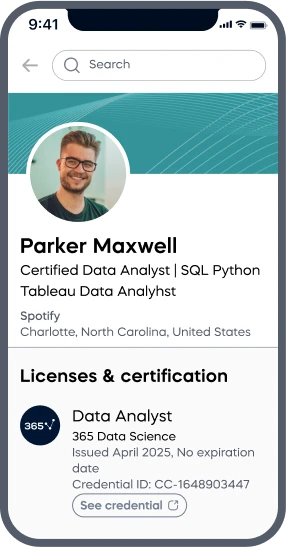
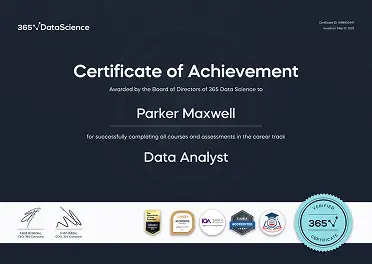
A LinkedIn profile mockup on a mobile screen showing Parker Maxwell, a Certified Data Analyst, with credentials from 365 Data Science listed under Licenses & Certification. A 365 Data Science Certificate of Achievement awarded to Parker Maxwell for completing the Data Analyst career track, featuring accreditation badges and a gold “Verified Certificate” seal.
  • Institute of Analytics
  • The Association of Data Scientists
  • E-Learning Quality Network
  • European Agency for Higher Education and Accreditation
  • Global Association of Online Trainers and Examiners

Where our Quant finance analyst
career path takes you

Start learning this path

How to become a Quant finance analyst—roadmap

Step 1
Education

Quantitative finance doesn’t follow one fixed degree path. Professionals may come from finance, mathematics, economics, physics, or computer science, and job titles can vary—from quantitative analyst and quant researcher to financial data scientist, risk modeler, or algorithmic trading analyst. What matters most is building the core skills employers look for: analytical thinking, programming, statistics, financial modeling, and practical experience with financial data.

You don’t need to follow a traditional route to begin a career in quantitative finance.

Employers increasingly prioritize practical quantitative and data analysis skills, making hands-on experience with tools like Python, econometrics, and time series analysis more important than ever. Enroll today to start building the skills required for a career in quantitative finance.

Step 2
Skills

Success in quantitative finance depends on strong mathematical foundations and modern data analysis skills. Python plays a central role in the field and is widely used for financial data analysis, quantitative modeling, and risk assessment. Employers value professionals who can work with financial datasets, apply statistical methods, and build predictive models using tools such as NumPy, pandas, econometrics, and time series analysis.

It may sound complex on paper, but these skills are highly learnable with the right guidance and hands-on practice.

Human judgment also remains essential. While models and algorithms can analyze large amounts of financial data, professionals must interpret results, evaluate risk, and make informed decisions in dynamic market conditions. Log in to start building the technical and analytical skills needed for quantitative finance.

Step 3
Branding

Certifications from trusted learning platforms can strengthen your credibility—especially in a field like quantitative finance where employers value demonstrated analytical and technical ability. A well-organized GitHub repository with quantitative finance projects, financial models, and data analysis workflows allows recruiters to quickly assess your practical skills.

Real-world projects and hands-on exercises provide clear evidence of your capabilities.

Focus on building projects—not just collecting credentials. Well-documented projects that demonstrate financial data analysis, time series modeling, risk modeling, or machine learning in finance can showcase your ability to solve real financial problems. When combined with structured training and recognized certifications, they help build the trust employers look for in quantitative finance professionals. Join our certified quant financial analyst training.

Quant Finance Analyst salary CALCULATOR

$
hours
Career track completion date *If you enroll today
Jun 2027
Expected annual salary increase (USD)
$116,550
You can start getting a higher salary in
15 months
Watch
Your Quant AnalystSALARY OUTLOOK
Year 1
Quant Analyst
$116,550
Year 2
Quant Analyst
$132,300
Year 3
Quant Analyst
$138,915
Year 4
Quant Analyst
$159,752
Year 5
Senior Quant Analyst
$206,850
Year 6
Senior Quant Analyst
$217,193
Year 7
Lead Quant Analyst
$249,772
Year 8
Lead Quant Analyst
$253,050
Year 9
Lead Quant Analyst
$265,703
Year 10
Principal Quant Analyst
$327,890
Your earnings over 10 years:

Are you a good match for a QUANT FINANCE ANALYST ROLE?

You’re curious about how financial markets behave—and, more importantly, how data can be used to model and predict them. If you enjoy working with numbers, analyzing patterns in financial data, and building quantitative models to evaluate risk and forecast outcomes, the quantitative finance analyst career path could be a strong match for you.

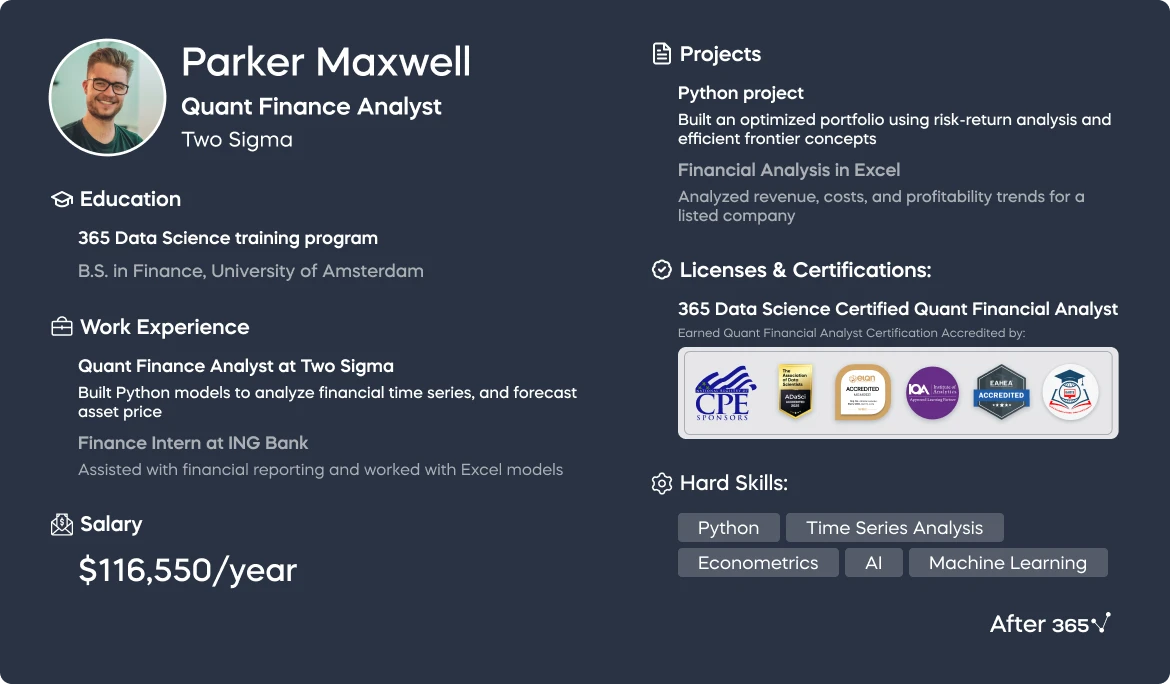
AI Engineer Profile Card

Frequently Asked Questions

Can’t find what you're looking for? Visit the 365 Data Science Help Center or Contact us

Is quantitative finance a good career path?

Yes. Quantitative finance is a high-demand and well-paid field that combines data science, mathematics, and finance. Professionals in this area work at investment banks, hedge funds, fintech companies, and asset management firms.

How do I become a quant analyst with Python?

Python is one of the most widely used tools in quantitative finance. By learning Python, NumPy, pandas, and financial modeling techniques, you can build trading models, analyze financial time series, and develop risk models used in investment firms and financial institutions.

What does a quantitative finance analyst do?

Quantitative finance analysts use data, statistics, and machine learning to analyze financial markets, build predictive models, assess risk, and support investment decisions.

How much does a quantitative finance analyst earn?

Salaries vary by experience and location, but quantitative finance analysts typically earn between $90,000 and $180,000+ per year, with senior quants and those working at hedge funds or trading firms often earning significantly more.

How do I become a quantitative finance analyst?

Most quant analysts combine programming, mathematics, and finance knowledge. Start by learning Python and data analysis, then study econometrics, financial modeling, and time series forecasting. Hands-on experience working with financial datasets and building predictive models is essential.

How do I start learning quantitative finance?

Begin by building a strong foundation in Python, statistics, and financial markets. Then learn how to work with financial data, apply econometrics, and analyze time series. From there, you can progress to advanced topics such as machine learning in finance and credit risk modeling.