
Data science is a multidisciplinary field that requires coding skills, an analytical mindset, and domain expertise. As AI and advanced analytics become more deeply integrated into insurance—from underwriting and pricing to claims management and fraud detection—data professionals also need to understand the industry’s terminology, business processes, regulatory requirements, and data-governance standards. In 2026, familiarity with generative AI, cloud platforms, and responsible model deployment is increasingly valuable alongside traditional statistics and machine learning.
In this article, we’ll touch upon the concept of insurance, as well as its types and benefits. Then, we’ll explore what data people in the insurance industry work with day to day. Next, we’ll see what skills you need to apply for data science in the insurance industry and the responsibilities you might be charged with once you land the job. Finally, we’ll discover the most common use cases that will probably get you interested to begin your first step.
Table of Contents
- Introduction to Insurance
- What Types of Data in Insurance Are There?
- What Are the Applications of Data Science in Insurance?
- What Is the Role of a Data Scientist in Insurance?
- What Are the Required Skills to Become a Data Scientist in Insurance?
- Useful Resources
- How to Become a Data Scientist in Insurance: Next Steps
Introduction to Insurance
We can define the concept of insurance in many ways. The simplest definition would be:
A mutual agreement between two parties, the insurance company or institution, often called the insurer, and the individual or business, known as the insured. An insurance policy is used to cover any financial loss one might experience because of sudden emergencies.
Of course, such contingencies can cause both emotional and financial loss, but only the latter can be compensated with money since insurance can be considered as a risk management technique where the insured pays a certain amount to the insurer, called a “premium”. Individuals can use this policy to protect anything whether it's their health, their lives, or even their cars.
Types of Insurance Coverage
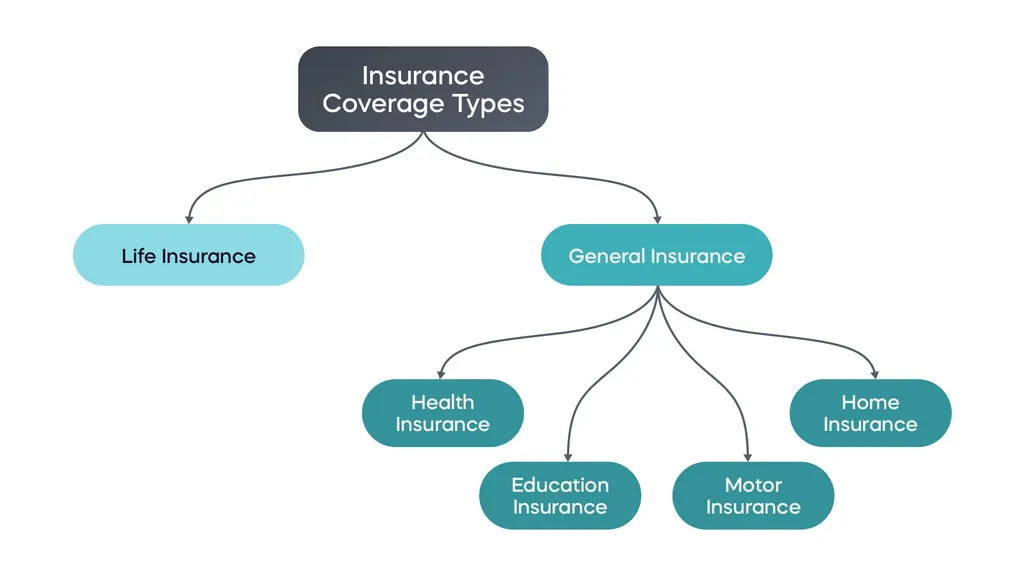
Insurance categories vary by country and regulatory framework. A common global distinction is between life insurance and non-life, or general, insurance, while some markets treat property and casualty, health, and life insurance as separate major segments.
Life Insurance
This type of policy is usually used by people with dependents where the insured pays a certain amount of money to the insurance company to be returned to the insured’s family in the event of sudden death.
General Insurance
This policy is further categorized into other types of insurance such as:
- Health Insurance. Since healthcare is one of the most expensive life services in most countries, it’s essential to ensure financial protection in case of any health-related conditions.
- Home Insurance. This is to compensate for any losses in one’s residence whether they’re a result of man-made accidents or natural disasters like earthquakes, floods, and hurricanes.
- Education Insurance. While not very common, it’s used mainly by parents for their children’s education. When the child reaches a certain age (usually 18), either they or the parent can take the money and invest it in higher education.
- Motor Insurance. As a vehicle owner, you can use the motor policy to compensate for any damage caused by road accidents. It’s important that you keep the insurance papers with you in the car all the time.
Benefits of Insurance
The benefits of insurance vary by policy and jurisdiction, but commonly include:
- It provides financial protection against covered losses.
- It allows risks and associated costs to be shared across a large group of policyholders.
- It can help individuals and businesses recover from unexpected events and maintain financial stability.
- Certain life insurance and annuity products can support long-term savings or retirement income.
- Some insurance products may receive favorable tax treatment, although the applicable rules vary by country, policy, and individual circumstances.
What Types of Data in Insurance Are There?
As the world’s population rises, you can imagine how much data is generated every day in the insurance industry. Unfortunately, a lot of it goes to waste at a time when leveraging its power can dramatically promote growth in all aspects. Insurance data analytics software development becomes crucial as we navigate the diverse data types, including actuarial, risk, financial, and consumer data. Discovering the applications of data science in insurance, we explore how it aids in fraud detection, personalized services, risk assessment, and more. Aspiring data scientists in the insurance sector must equip themselves with domain knowledge, programming language fluency, and skills to contribute effectively to the field's dynamic landscape.
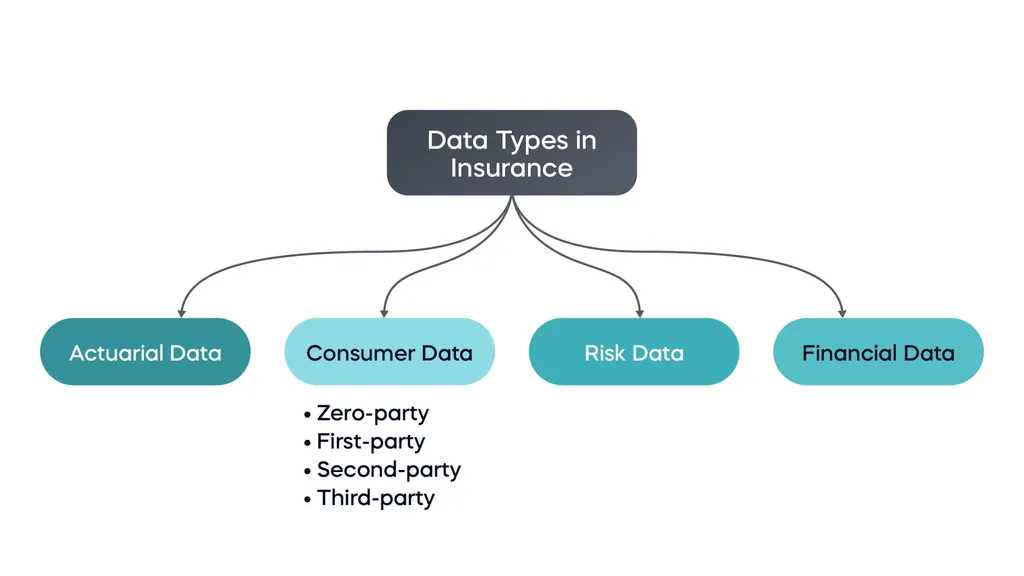
There are different data types involved in the daily processes and transactions between insurers, insured individuals, and many other parties, the main ones being:
- Actuarial data
- Risk data
- Financial data
- Consumer data
We can further categorize consumer data into 4 different types:
- Zero-party data comes directly from consumers and can be collected using polls and surveys about their needs and preferences.
- First-party data, collected from e-mails, web visits, and more, concerns itself with consumers’ activity.
- Second-party data is also consumers’ data but collected by a third, external company. Marketing specialists can use this data to improve customer experience and develop partnerships.
- Third-party data, which insurance companies can attain from third-party providers that collect data about consumers from a variety of sources. Combining this external source with the other 3 types of consumer data makes the perfect combination for creating detailed customer profiles.
What Are the Applications of Data Science in Insurance?
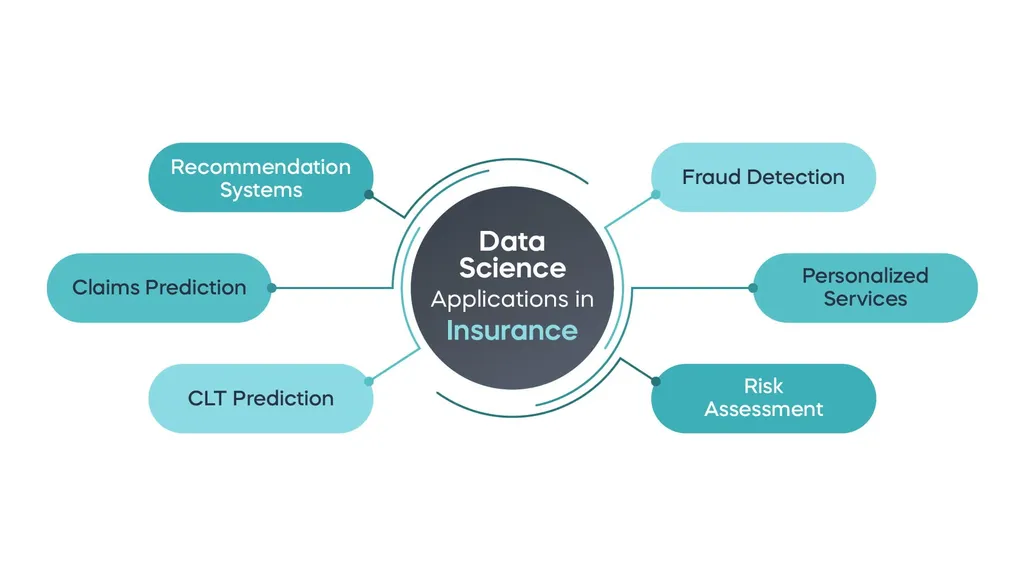
From fraud detection to predicting lifetime value, using data science techniques has helped insurance companies reduce costs and provide better services. These are the most known applied use cases of data science in insurance:
- Preventing financial losses by detecting fraudulent activity using predictive modeling techniques.
- Personalizing services and policy offers with advanced analytics to extract valuable insights about customers.
- Using the matrix model to define and assess financial risks.
- Predicting customer lifetime value by analyzing customer behavior data.
- Predicting future claims using models like logistic regression and random forests.
- Building recommendation engines using special filtering systems to recommend the most relevant products to the customers.
What Is the Role of a Data Scientist in Insurance?
A proficient team of data professionals can improve nearly every process in the field. As a data scientist in insurance, you need to practice the workflow cycle from managing and analyzing data to reporting and presenting insights to other team members.
Based on the ‘data scientist in insurance’ job descriptions we’ve looked into as research, these are the type of tasks your work might revolve around:
- Working with large, sensitive datasets from multiple sources and performing exploratory data analysis.
- Developing and validating statistical, machine learning, natural language processing, computer vision, or generative AI solutions.
- Translating problems in underwriting, pricing, claims, fraud detection, and customer service into well-defined analytical projects.
- Collaborating with actuaries, underwriters, claims specialists, product managers, data engineers, software engineers, and compliance teams.
- Helping deploy models into production and monitoring their performance, reliability, and data or model drift.
- Communicating findings and model limitations to technical and non-technical stakeholders.
- Documenting data sources, assumptions, explainability, fairness, privacy considerations, and regulatory requirements.
Of course, this is not all you’ll be doing─like you’ve already learned, data science has many applications in insurance.
What Are the Required Skills to Become a Data Scientist in Insurance?
If you intend on working as a data scientist in this sector, then it’s going to take some extra steps to build an adequate knowledge base. We’ll now break down the skills you need to work with data science in insurance.
Domain Knowledge
You don’t need to be a qualified actuary to work as a data scientist in insurance, but you should understand how the industry operates. Familiarity with insurance products, premiums, underwriting, claims, pricing, reserving, fraud, and regulatory requirements will help you define problems correctly and interpret your results.
Actuarial science uses mathematics, statistics, and financial theory to assess risk and uncertainty, particularly in areas such as pricing, reserving, and capital management. A basic understanding of actuarial concepts is valuable for most insurance data scientists, while deeper actuarial knowledge may be required for roles closely connected to pricing or financial risk.
Programming Language Fluency
We all know that coding fluency is a standard to work in any data-related field. Since you’ll be dealing with data from different sources, it’s preferred to know more than one coding language.
Of course, you can start with Python which is quite easy to learn. When you have a strong grasp of the basics, you can check other languages such as R and Java. It’s also important to learn SQL to know how to manage, extract and store databases. The language is easy to learn, much like Python.
Remember, you don’t have to learn everything at once! Just take it step by step and make sure that you practice what you’ve learned.
Mathematics and Statistics
To break into data science in insurance, you need strong math and statistics abilities as most of the time you’ll probably be running statistical models. Moreover, you’ll also need them to analyze financial data and assess financial risks with probability analysis.
Machine Learning
There are many applications of machine learning in insurance (which we’ll elaborate on later). Therefore, you need to know a little bit about machine learning and specifically how to build predictive models to forecast future events─this is one of the main tasks a data scientist in insurance would do.
Soft Skills
Soft (or interpersonal) skills are probably the glue that holds your technical skills together. Knowing how to communicate your findings is as important as reaching them. Meanwhile, critical thinking and problem-solving contribute to your ability to resolve different business problems.
And while data visualization isn’t a soft skill, it’s still important to mention. Good visualizations will help you present your findings to the stakeholders in your insurance company in the most simple and appealing way.
Useful Resources
Data Science Courses
- Introduction to Python
This course will introduce you to the world of Python. You will learn about its technical advantages, specific features, modules, functionalities, and more. - Introduction to SQL
SQL is a must if you are expected to work with databases. This course is the ultimate guide, teaching you everything you need to know in terms of database management and creating SQL queries. - Introduction to Mathematics
This short course focuses on calculus and linear algebra so that you cover the basic foundations you’ll need to develop powerful algorithms. - Introduction to Statistics
This course begins with the very basics of statistics and builds up your arithmetic thinking. It gradually teaches you how to work with more complex analyses, statistical approaches, and hypotheses. - Machine Learning in Python
This course is focused on predictive modeling via an array of approaches such as linear regression, logistic regression, and cluster analysis. It combines comprehensive theory with lots of practice to allow you to exercise your Python skills.
To round out your learning path, consider studying Git and software-engineering practices, cloud computing, MLOps, model monitoring, explainable AI, data governance, and generative AI. These topics will help you build solutions that are not only accurate in a notebook but also reliable, auditable, and appropriate for use in a regulated industry.
Further Reading
- Actuarial Science
- What is Insurance?
- Analytics: The real-world use of big data in insurance
- Data Science in the Insurance Industry
- Top 10 Data Science Use Cases in Insurance
- Why Data Science is a Game Changer for Insurance Industry Today and Tomorrow
- The Need for Data and AI Skills in the Insurance Industry
- Data Analytics in Insurance Industry | The Ultimate Guide
How to Become a Data Scientist in Insurance: Next Steps
Now that you have a clear blueprint of data science in insurance, you can start right away with designing your study plan according to your time. You can start with an introduction to actuarial science and also test your current level in Python and SQL.
To make your profile more competitive in 2026, build at least one end-to-end insurance project that demonstrates data preparation, model validation, reproducibility or deployment, clear communication, and responsible handling of sensitive data. A project focused on claims, underwriting, fraud detection, or a carefully governed generative AI assistant can demonstrate both technical ability and domain awareness.
And as usual, we’re here to help you do that in the simplest way. From comprehensive introductions to Python and R to key considerations in machine learning, the 365 Data Science Program has everything you need to break into the field.
Under the guidance of leading industry experts, you will learn by doing with a myriad of practical exercises and real-world business cases. If you want to see how the training works, start with a selection of free lessons by signing up below.